Today's
EarthStation1.com 15% Off Commemorative Memorial Title:
Appointment With Destiny: The Crucifixion Of Jesus MP4 Download Or
DVD
Today, April 5, 2026
April 5, 2026: First Sunday After The
Paschal Full Moon (First Full Moon On Or After March 21):
Eastertide (Eastertime, Easter Season, Paschaltide, Paschaltime,
Paschal Season): Octave Of Easter (Easterweek): Bright Week:
Holyweek: Easter (Easter Sunday, Pascha, Resurrection Sunday):
Easter: -- A festival and holiday celebrating the resurrection of
Jesus from the dead, described in the New Testament as having
occurred on the third day of his burial after his crucifixion by
the Romans at Calvary c. 30 AD. It is the culmination of the
Passion of Jesus, preceded by Lent (or Great Lent), a forty-day
period of fasting, prayer, and penance. Most Christians refer to
the week before Easter as "Holy Week" as it contains the
three days of the Easter Triduum: 1) Maundy Thursday,
commemorating the washing of the feet and Last Supper, 2) Good
Friday, commemorating the crucifixion and death of Jesus, and 3)
Easter Sunday, when Jesus was resurrected. In Western
Christianity, Eastertide, or the Easter Season, begins on Easter
Sunday and lasts seven weeks, ending with the coming of the
fiftieth day, Pentecost Sunday. In Eastern Christianity, the
season of Pascha begins on Pascha and ends with the coming of the
fortieth day, the Feast of the Ascension. Easter and the holidays
that are related to it are moveable feasts which do not fall on a
fixed date in the Gregorian or Julian calendars which follow only
the cycle of the sun; rather, its date is determined on a
lunisolar calendar similar to the Hebrew calendar. The First
Council of Nicaea (325) established two rules, independence of the
Jewish calendar and worldwide uniformity, which were the only
rules for Easter explicitly laid down by the council. No details
for the computation were specified; these were worked out in
practice, a process that took centuries and generated a number of
controversies. It has come to be the first Sunday after the
ecclesiastical full moon that occurs on or soonest after 21 March,
but calculations vary. Easter is linked to the Jewish Passover by
much of its symbolism, as well as by its position in the calendar.
In most European languages the feast called Easter in English is
termed by the words for passover in those languages and in the
older English versions of the Bible the term Easter was the term
used to translate passover. Easter customs vary across the
Christian world, and include sunrise services, exclaiming the
Paschal greeting, clipping the church (where the congregation or
local children hold hands in an outward-facing ring around the
church), and decorating Easter eggs as symbols of the empty tomb.
The Easter lily, a symbol of the resurrection, traditionally
decorates the chancel area of churches (the area around the altar)
on this day and for the rest of Eastertide. Additional customs
that have become associated with Easter and are observed by both
Christians and some non-Christians include egg hunting, the Easter
Bunny, and Easter parades. There are also various traditional
Easter foods that vary regionally. The modern English term Easter,
cognate with modern Dutch ooster and German Ostern, developed from
an Old English word that usually appears in the form Eastrun,
Eastru, Eastre or Eostre. The most widely accepted theory of the
origin of the term is that it is derived from the name of an Old
English goddess mentioned by the 7th to 8th-century English monk
Bede, who wrote that Eosturmonath (Old English 'Month of Eostre',
translated in Bede's time as "Paschal month") was an
English month, corresponding to April, which he says "was
once called after a goddess of theirs named Eostre, in whose
honour feasts were celebrated in that month". #Easter
#EasterSunday #Pascha #ResurrectionSunday #ResurrectionOfJesus
#ResurrectionOfJesus #EasterLillies #FloweringTheCross #EasterEggs
#EasterBonnets #EmptyTomb #SunriseService #ClippingTheChurch
#EggHunts #EasterFood #EasterParades #Eastertide #OctaveOfEaster
#EasterWeek #BrightWeek #HolyWeek #PassionOfJesus
#ChristianHolidays #JesusChrist #Christianity
#ChristianMoveableFeasts #Holidays #Christianity #MoveableFeasts
#ChristianSky #EasterSky #MP4 #VideoDownload #DVD On Sale @ 15%
Off Discount Till Midnight PT!
https://store.earthstation1.com/appointment-with-destiny-the-crucifixion-of-jesus-dvd.html
Today's
EarthStation1.com 15% Off Commemorative Memorial Title: Jack Benny
Complete Radio Broadcasts Set MP3 DVD, Audio Download, USB
Today, April 5, 2026
April 5, 2026: First Sunday After The
Paschal Full Moon (First Full Moon On Or After March 21):
Eastertide (Eastertime, Easter Season, Paschaltide, Paschaltime,
Paschal Season): Octave Of Easter (Easterweek): Bright Week:
Holyweek: Easter (Easter Sunday, Pascha, Resurrection Sunday):
National Baked Ham With Pineapple Day: -- We can celebrate Easter
with a yummy dish of baked ham adorned with beautifully cut
pineapple slices. National Baked Ham with Pineapple Day is
celebrated on the same day as Easter every year. They are both
celebrated on the first Sunday after the full moon following the
March Equinox. Easter is best suited for this day since the tables
will already be filled with delicious dishes that include ham.
March to July is the peak season for a juicy harvest of
pineapples, and there is no better time to celebrate. There aren't
many people who don't love the combination of the smoky, salty,
and sweet tastes of ham. The same goes for the sweet, with a hint
of sourness, and juicy pineapple taste. We believe the Chinese
were the first to cure pork leg into ham in 4900 B.C. The
popularity of ham rose around the world when Europeans started
trading with China. Pineapples were already popular among the
native tribes of the South and Central American forests. We
believe it originated in the Brazilian forests. Pineapples became
popular in Europe through colonization. It became a delicacy and
soon spread throughout the world. Easter is one of the most
important days in Christianity. It is a day to celebrate the
resurrection of Jesus Christ, after the crucifixion, on the third
day. But there are a few other theories among historians regarding
the origin of Easter. Some people believe that the origin can be
traced back to pagan traditions and festivals. Historians believe
Christianity incorporated various pagan traditions, cultures, and
festivals to easily convert others to Christianity. Various Easter
traditions also have similar backstories. The Easter lamb was a
prominent tradition where the devotees placed the meat of a lamb
under an altar. The meat is then blessed and consumed on Easter
day. This tradition has further expanded to include ham, eggs,
cheese, etc. Decorated or colored Easter eggs and the Easter bunny
are a few other traditions formed over the years. At some point in
history, decorating ham, made for Easter, with pineapple slices
became popular. It grew in popularity, and a day was born to mark
the baked ham with pineapple. On Sale @ 15% Off Discount Till
Midnight PT!
https://store.earthstation1.com/jack-benny-complete-radio-broadcasts-dual-layer-mp3-dv3.html
Today's
EarthStation1.com 15% Off Commemorative Memorial Title:
Counterculture Of The 1960s Films MP4 Video Download DVD
Today, April 5, 2026
April 5: Bell Bottoms Day (Bell-Bottoms
Day, Flares Day): -- Commemorates the centuries-old fashion of
trousers that become wider from the knees to the ankles resembling
the shape of a bell. Bell Bottoms, also stylized bell-bottoms,
have been worn for centuries by European carpenters, since the
widening of the pants bottoms prevented sawdust from falling onto
their shoes or feet. In the early 19th century, before a
standardised uniform for sailors in both The Royal Navy and The
U.S. Navy existed, some sailors adopted a style of wide trousers
ending in bell-shaped cuffs, which served to protect footwear from
exposure to water. In 1813, one of the first recorded descriptions
of sailors' uniforms, written by the distinguished U.S. Navy
Commodore Stephen Decatur (famed for his naval victories against
Britain, France, and the Barbary Pirates) noted that men on the
frigates United States and Macedonia wore "glazed canvas hats
with stiff brims, decked with streamers of ribbon, blue jackets
buttoned loosely over waistcoats, and blue trousers with bell
bottoms." In the 1960s bell-bottoms became fashionable for
both men and women in London, and this popularity quickly expanded
throughout Europe and North America, becoming a standard fashion
during the 1960s, 1970s, 1980s and 1990s. Today bell bottoms are
ordinarily made from denim, satin polyester, or bright cotton.
They were immensely popular among the youth culture and
counterculture of the 1960s, and they continue to prove useful in
uniforms throughout the world where protection of footwear is
desirable or required, such as traffic police. On Sale @ 15% Off
Discount Till Midnight PT!
https://store.earthstation1.com/counterculture-film-collection-dual-layer-dvd.html
Today's
EarthStation1.com 15% Off Commemorative Memorial Title: The
Eleanor Roosevelt Story 1965 Biographical Film DVD, Download, USB
Today, April 5, 2026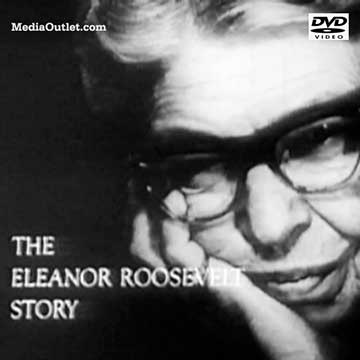
April 5: The International Day Of
Conscience: -- A day started by the United Nations General
Assembly commemorating the importance of the human conscience. The
human conscience is an important intellectual quality that
differentiates us from the rest of the animal kingdom. The human
mind is an amazing and complex unit, and the human conscience is
even more so. This is a day to promote the importance of
self-reflection and doing the right thing. This day also helps to
improve society's collective good by identifying the corrections
that need to be done. Conscience is a challenging and complex
concept. It can be generally described as a person's moral sense
of right and wrong. It is also a guide to one's behavior. The
personal ethics a person keeps to not steal from another or not
cheat on an exam is a good example of conscience. In simple terms,
it is the knowledge about ourselves. His Royal Highness Prince
Khalifa bin Salman Al Khalifa, the Prime Minister of the Kingdom
of Bahrain, sponsored an initiative on the 73rd session of the
United Nations General Assembly. The initiative was to designate
April 5 as an International Day of Conscience. The assembly
adopted the resolution and titled it 'Promoting the Culture of
Peace with Love and Conscience.' This resolution invites people to
build a culture of peace with love and conscience as per their
personal situation and culture. The day has an open-minded
approach that is acceptable for people all over the world to
promote peace and love. Peace is not just the absence of violence
and conflicts; it is also a state of continuous evolution by
incorporating the principles of justice, development, and good
governance. Conscience can help people realize this and create
better bonds with people and the environment around them. It can
also create a sense of righteousness and help create better
connections between nations. On Sale @ 15% Off Discount Till
Midnight PT!
https://store.earthstation1.com/the-eleanor-roosevelt-story-dvd-1965-macleish-seva1965.html
Today's
EarthStation1.com 15% Off Commemorative Memorial Title: Go For
Broke WWII Japanese-American 442nd Infantry DVD, MP4, USB Drive
Today, April 5, 2026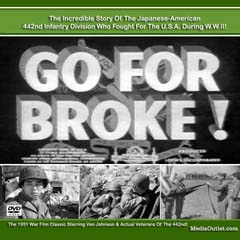
April 5: National Go For Broke Day: --
EarthStation1 MediaOutlet is especially excited to celebrate a day
marked in honor of one of the finest American military units that
fought for peace and saw to the end of World War II - the 442nd
Regimental Combat Team of the United States Army. Did you know
that the members of this military unit were all American Japanese?
Yes, and their grit and commitment to duty made them a
well-reckoned unit worthy of remembering. 'Go for broke'
originated from Hawaiian Pidgin slang used by craps players, which
means to 'wager all' or 'bet everything in a single roll.' The
inception of the slang as a motto by the 442nd Regimental Combat
Team of the United States Army, in addition to the great deeds
they performed during World War II, solidified the phrase in the
heart of everyone as a catchphrase for commitment, perseverance,
hard work, and integrity. It embodies giving your all into
whatever it is you find yourself doing, and pressing on no matter
the odds or challenges you face. During World War II, after the
bombing of Pearl Harbor in Hawaii, concerns arose from the
government and citizens alike towards the Japanese Americans
living within America who were also called Nisei. In less than a
few weeks after the attack, all Japanese American men of draft age
were regarded as enemy aliens and put under the scrutiny of
suspicion by all and sundry. This gave rise to the patriotic
efforts of the Nisei as they strove to fight against racial
discrimination and also make known their commitment, love, and
willingness to serve the country. After several lobbying efforts,
many Japanese-Americans (known as 'Nisei') were given the
opportunity to serve America through the 100th Infantry Battalion,
the 1399th Engineer Construction Battalion, the Military
Intelligence Service, and the 4442nd Regimental Combat Team. The
100th Infantry Battalion formed in June 1942 - it was the War
Department's way of ascertaining whether soldiers of Japanese
descent could be trusted in battle. This unit performed
brilliantly and became known as the Purple Heart Battalion. They
removed all doubts and questions of loyalty, and this resulted in
the eventual deployment of the 442nd Regimental Combat Team in
June 1944. The 4442nd R.C.T. proved their strength and patriotism
on the battlefield, fighting against numerous odds and winning
landslide victories for the country. By the end of the war, they
became the most decorated regiment in the country with over 18,000
individual soldiers decorated. They received seven presidential
unit Citations, two Meritorious Service Plaques, 36 Army
Commendation Medals, 87 Division Commendations, 21 Medals of
Honor, nearly 4,000 Purple Hearts, and more. On Sale @ 15% Off
Discount Till Midnight PT!
https://store.earthstation1.com/go-for-broke-dvd-japaneseamerican-442nd-infantry-division-w442.html
Today's
EarthStation1.com 15% Off Commemorative Memorial Title: Alexander
Nevsky (Aleksandr Nevskiy) 1938 DVD, MP4 Download, USB Drive
Today, April 5, 2026
April 5: Russian Days of Military Honour:
-- April 5, 1242: The History Of Christianity: The History Of
Roman Catholicism: The Latin Church (Latin: Ecclesia Latina): The
Middle Ages (The Medieval Period, The Mediaeval Period): The
Crusades: The Northern Crusades (The Baltic Crusades): The
Livonian Campaign Against Rus': The Battle On The Ice (The Battle
Of Lake Peipus): -- Russian forces of the Republic of Novgorod,
led by Prince Alexander Nevsky, rebuff an invasion attempt by the
crusader army led by the Livonian branch of the Teutonic Knights.
The battle is notable for having been fought largely on the frozen
lake, and this gave the battle its name. The battle was a
significant defeat sustained by the crusaders during the Northern
Crusades, which were directed against pagans and Eastern Orthodox
Christians rather than Muslims in the Holy Land. The Crusaders'
defeat in the battle marked the end of their campaigns against the
Orthodox Novgorod Republic and other Slavic territories for the
next century. The event was glorified in Sergei Eisenstein's
historical drama film Alexander Nevsky, released in 1938, which
created a popular image of the battle often mistaken for the real
events. Sergei Prokofiev turned his score for the film into a
concert cantata of the same title, with "The Battle On The
Ice" being its longest movement. On Sale @ 15% Off Discount
Till Midnight PT!
https://store.earthstation1.com/alexander-nevsky-dvd-aka-aleksandr-nevskiy.html
Today's
EarthStation1.com 15% Off Commemorative Memorial Title: Black
Civil Rights Films: African-American History DVD, MP4, USB Stick
Today, April 5, 2026
April 5, 1856: #BOTD: #HBD! Booker T.
Washington, African American educator, author, essayist, orator,
adviser to multiple presidents of the United States, founder of
the Tuskegee Institute and the National Negro Business League,
Prince Hall Freemason and historian (d. 1915) is #born Booker
Taliaferro (Taliaferro: Italian, "Ironcutter")
Washington as a slave in Franklin County, Virginia; the Taliaferro
(originally Tagliaferro, which means 'Ironcutter' in Italian) are
a prominent family in eastern Virginia and Maryland who were one
of the early families who settled in Virginia in the 17th century,
having migrated from London, where an ancestor had served as a
musician in the court of Queen Elizabeth I in family line believed
to trace back to Bartholomew Taliaferro, a native of Venice who
settled in London and was made a denizen in 1562. Between 1890 and
1915, Booker T. Washington was the dominant leader in the African
American community and of the contemporary black elite. Washington
was from the last generation of black American leaders born into
slavery and became the leading voice of the former slaves and
their descendants. They were newly oppressed in the South by
disenfranchisement and the Jim Crow discriminatory laws enacted in
the post-Reconstruction Southern states in the late 19th and early
20th centuries. Washington was a key proponent of African American
businesses and one of the founders of the National Negro Business
League. His base was the Tuskegee Institute, a historically black
college he founded in Tuskegee, Alabama. As lynchings in the South
reached a peak in 1895, Washington gave a speech, known as the
"Atlanta compromise", which brought him national fame.
He called for black progress through education and
entrepreneurship, rather than trying to challenge directly the Jim
Crow segregation and the disenfranchisement of black voters in the
South. Washington mobilized a nationwide coalition of middle-class
blacks, church leaders, and white philanthropists and politicians,
with a long-term goal of building the community's economic
strength and pride by a focus on self-help and schooling. With his
own contributions to the black community, Washington was a
supporter of racial uplift, but secretly he also supported court
challenges to segregation and to restrictions on voter
registration. Black activists in the North, led by W. E. B. Du
Bois, at first supported the Atlanta compromise, but later
disagreed and opted to set up the National Association for the
Advancement of Colored People (NAACP) to work for political
change. They tried with limited success to challenge Washington's
political machine for leadership in the black community, but built
wider networks among white allies in the North. Decades after
Washington's death in 1915, the civil rights movement of the 1950s
took a more active and progressive approach, which was also based
on new grassroots organizations based in the South, such as
Congress Of Racial Equality (CORE), the Student Nonviolent
Coordinating Committee (SNCC) and Southern Christian Leadership
Conference (SCLC). Washington mastered the nuances of the
political arena in the late 19th century, which enabled him to
manipulate the media, raise money, develop strategy, network,
push, reward friends, and distribute funds, while punishing those
who opposed his plans for uplifting blacks. His long-term goal was
to end the disenfranchisement of the vast majority of African
Americans, who then still lived in the South. His legacy has been
very controversial to the civil rights community, of which he was
an important leader before 1915. After his death, he came under
heavy criticism for accommodationism to white supremacy. However,
a more balanced view of his very wide range of activities has
appeared since the late 20th century. As of 2010, the most recent
studies, "defend and celebrate his accomplishments, legacy,
and leadership". Booker T. Washington was made a mason at
Sight by the by the M.W. Grand Master of the Prince Hall Grand
Lodge of Massachusetts. He died on November 14, 1915 of Bright's
disease in Tuskegee at the age of 59. His funeral was held on
November 17, 1915 in the Tuskegee Institute Chapel and it was
attended by nearly 8,000 people. He was buried nearby in the
Tuskegee University Campus Cemetery. At the time he was thought to
have died by congestive heart failure, aggravated by overwork. In
March 2006, his descendants permitted examination of medical
records: these showed he had hypertension, with a blood pressure
more than twice normal, confirming what had long been suspected.
At Washington's death, Tuskegee's endowment was close to 2M USD.
Washington's greatest life's work, the education of blacks in the
South, was well underway and expanding. #BookerTWashington
#AfricanAmericans #BlackAmericans #BlackPeople #Blacks #Freemasons
#Masons #PrinceHallMasons #PrinceHallMasonry #Slaves #Tuskegee
#TuskegeeInstitute #TuskegeeUniversity
#HistoricallyBlackCollegesAndUniversities #HBCUs #TuskegeeAlabama
#Education #NationalNegroBusinessLeague #NNBL
#NationalBusinessLeague #NBL #AfricanAmericanBusinesses
#AtlantaCompromise #DisenfranchisementAfterTheReconstructionEra
#JimCrow #PostReconstruction #AfricanAmericanHistory
#AfricanAmericanHeritage #BlackHeritage #HistoryOfAfricanAmericans
#BlackAmericanHistory #HistoryOfBlackAmericans #AmericanHistory
#HistoryOfTheUS #WesternCulture #WesternCivilization
#OccidentalCulture #WesternWorld #WesternSociety #WesternTradition
#StoryOfCivilization #MP4 #VideoDownload #DVD On Sale @ 15% Off
Discount Till Midnight PT!
https://store.earthstation1.com/black-civil-rights-films-africanamerican-history-dvd.html
Today's
EarthStation1.com 15% Off Commemorative Memorial Title: Native
North American Indian History Documentaries MP4 Downloads DVDs
Today, April 5, 2026
April 5, 1614: The Colonial History Of
The United States: The British Colonization Of The Americas: The
Colony Of Virginia: The Jamestown, Virginia Colony (1607-1624):
Tsenacommacah (Tscenocomoco, Tsenacomoco, Tenakomakah,
Attanoughkomouck, Attan-Akamik): Native American Tribes In
Virginia: The Powhatan People: Pocahontas (Amonute, Matoaka): The
Marriage Of Pocahontas And John Rolfe: -- Pocahontas, Native
American woman notable for her association with the colonial
settlement at Jamestown, Virginia, marries English colonist John
Rolfe in Virginia. Pocahontas (born Matoaka, known as Amonute, c.
1596 - March 1617) was the daughter of Powhatan, the paramount
chief of a network of tributary tribal nations in the
Tsenacommacah, encompassing the Tidewater region of Virginia. In a
well-known historical anecdote, she saved the life of a captive of
the Native Americans, the Englishman John Smith, in 1607 by
placing her head upon his own when her father raised his war club
to execute him. A large number of historians doubt the veracity of
this story. Pocahontas was captured and held for ransom by the
English during Anglo-Indian hostilities in 1613. During her
captivity, she converted to Christianity and took the name
Rebecca. When the opportunity arose for her to return to her
people, she chose to remain with the English. In April 1614, at
the age of 17, she married tobacco planter John Rolfe, and in
January 1615, bore their son, Thomas Rolfe. In 1616, the Rolfes
travelled to London. Pocahontas was presented to English society
as an example of the "civilized savage" in hopes of
stimulating investment in the Jamestown settlement. She became
something of a celebrity, was elegantly feted, and attended a
masque (a form of festive courtly entertainment that flourished in
16th- and early 17th-century Europe) at Whitehall Palace, the main
residence of the English monarchs from 1530 until 1698. In 1617,
the Rolfes set sail for Virginia, but Pocahontas died at Gravesend
of unknown causes, aged around 20-21. She was buried in St
George's Church, Gravesend in England, but the exact location of
her grave is unknown, as the church has been rebuilt. Numerous
places, landmarks, and products in the United States have been
named after Pocahontas. Her story has been romanticized over the
years, and she is a subject of art, literature, and film. Many
famous people have claimed to be among her descendants through her
son Thomas, including members of the First Families of Virginia,
First Lady Edith Wilson, American Western actor Glenn Strange, Las
Vegas performer Wayne Newton, and astronomer Percival Lowell. John
Rolfe (1585-1622) was one of the early English settlers of North
America. He is credited with the first successful cultivation of
tobacco as an export crop in the Colony of Virginia. On Sale @ 15%
Off Discount Till Midnight PT!
https://store.earthstation1.com/native-north-american-indian-history-documentaries-dvd-mp4-us4.html
Today's
EarthStation1.com 15% Off Commemorative Memorial Title: December
7th: The Movie 1943 Walter Huston John Ford DVD, MP4, USB
Today, April 5, 2026
April 5, 1883: #BOTD: #HBD! Walter
Huston, Canadian-American actor and singer (d. April 7, 1950) is
#born Walter Thomas Houghston in Toronto, Canada. Walter Huston
won the Academy Award for Best Supporting Actor for his role in
The Treasure of the Sierra Madre, directed by his son John Huston.
He is the patriarch of the four generations of the Huston acting
family, including his son John Huston, Anjelica Huston, Danny
Huston, Allegra Huston and Jack Huston. The Huston family has
three generations of Academy Award winners: Walter himself; his
son, film director, screenwriter and actor John Huston; and John
Huston's daughter, Anjelica Huston. Walter Huston died of an
aortic aneurysm in his hotel suite in Beverly Hills, two days
after his 67th birthday. His cremains were given to his widow
Ninetta (Nan) Sunderland On Sale @ 15% Off Discount Till Midnight
PT!
https://store.earthstation1.com/december-7th-1943-john-ford-gregg-toland-fulllength-feature71943.html
Today's
EarthStation1.com 15% Off Commemorative Memorial Title: The Minoan
Civilization Sir Arthur Evans MP4 Video Download DVD
Today, April 5, 2026
April 5, 1900: Archaeology (Archeology): Great Discoveries Of Archaeology: The Minoan Civilization: Linear B: The Knossos Tablets: -- Archaeologists excavating the palace of Knossos, Crete discover the first large cache ever of Linear B tablets, clay tablets with hieroglyphic writing in a script they call Linear B, among the remains of a wooden box in a disused terracotta bathtub. The details of the discovery are recorded in British archaeologist and pioneer in the study of Knossos Sir Arthur John Evans' report to the British School at Athens for that year. Subsequently, caches turned up at multiple locations, including the Room of the Chariot Tablets, where over 350 pieces from four boxes were found. The tablets were 4.5 cm (1.8 in) to 19.5 cm (7.7 in) long by 1.2 cm (0.47 in) to 7.2 cm (2.8 in) wide and were scored with horizontal lines over which text was written in about 70 characters. Even in this earliest excavation report, Evans could tell that "a certain number of quasi-pictorial characters also occur which seem to have an ideographic or determinative meaning." Linear B is a syllabic script that was used for writing in Mycenaean Greek, the earliest attested form of the Greek language. The script predates the Greek alphabet by several centuries, the earliest known examples dating to around 1400 BC. It is adapted from the earlier Linear A, an undeciphered script potentially used for writing the Minoan language, as is the later Cypriot syllabary, which also recorded Greek. Linear B, found mainly in the palace archives at Knossos, Kydonia, Pylos, Thebes and Mycenae, disappeared with the fall of Mycenaean civilization during the Late Bronze Age collapse. The succeeding period, known as the Greek Dark Ages, provides no evidence of the use of writing. Linear B was deciphered in 1952 by English architect and self-taught linguist Michael Ventris] based on the research of American classicist Alice Kober. It is the only Bronze Age Aegean script to have been deciphered, with Linear A, Cypro-Minoan, and Cretan hieroglyphic remaining unreadable. Linear B consists of around 87 syllabic signs and over 100 ideographic signs. These ideograms or "signifying" signs symbolize objects or commodities. They have no phonetic value and are never used as word signs in writing a sentence. The application of Linear B appears to have been confined to administrative contexts. In all the thousands of clay tablets, a relatively small number of different people's handwriting have been detected: 45 in Pylos (west coast of the Peloponnese, in Southern Greece) and 66 in Knossos (Crete). Once the palaces were destroyed, the script disappeared. On Sale @ 15% Off Discount Till Midnight PT! https://store.earthstation1.com/micisirarevm.html
Today's
EarthStation1.com 15% Off Commemorative Memorial Title: The Old
Time Radio Drama MP3 MegaSet DVD, Audio Download, USB Stick
Today, April 5, 2026
April 5, 1900: #BOTD: #HBD! Spencer
Tracy, American actor, one of the major stars of Hollywood's
Golden Age known for his natural performing style and versatility
(d. June 10, 1967) is #born Spencer Bonaventure Tracy in
Milwaukee, Wisconsin. Spencer Tracy won two Academy Awards for
Best Actor from nine nominations, sharing the record for
nominations in the category with Laurence Olivier. Tracy first
discovered his talent for acting while attending Ripon College,
and he later received a scholarship for the American Academy of
Dramatic Arts. He spent seven years in the theatre, working in a
succession of stock companies and intermittently on Broadway.
Tracy's breakthrough came in 1930, when his lead performance in
The Last Mile caught the attention of Hollywood. After a
successful film debut in John Ford's Up the River starring Tracy
(and also featuring Humphrey Bogart), he was signed to a contract
with Fox Film Corporation. His five years with Fox featured one
acting tour de force after another that were usually ignored at
the box office, and he remained largely unknown to audiences after
25 films, almost all of them starring Tracy as the leading man.
None of them were hits although his performance in The Power and
the Glory (1933) was praised at the time. In 1935, Tracy joined
Metro-Goldwyn-Mayer, then Hollywood's most prestigious studio. His
career flourished from Fury (1936) onwards, and in 1937 and 1938
he won consecutive Oscars for Captains Courageous and Boys Town.
He made three box-office successes supporting Clark Gable, the
studio's most prominent leading man so that by the early 1940s,
Tracy was one of the studio's top stars. In 1942, he appeared with
Katharine Hepburn in Woman of the Year, beginning another
partnership leading to nine movies over 25 years. Tracy left MGM
in 1955, and continued to work regularly as a freelance star,
despite an increasing weariness as he aged. His personal life was
troubled, with a lifelong struggle against severe alcoholism and
guilt over his son's deafness. Tracy became estranged from his
wife in the 1930s, but the couple never divorced, conducting a
long-term relationship with Katharine Hepburn in private. Towards
the end of his life, Tracy worked almost exclusively for director
Stanley Kramer. It was for Kramer that he made his last film,
Guess Who's Coming to Dinner (1967), completedjust 17 days before
he died of a heart attack in his Beverly Hills, California
apartment home, aged 67. Tracy spent most of the last two years of
his life at home with Hepburn, living what she described as a
quiet life: reading, painting, and listening to music. On June 10,
1967, 17 days after completing what was his last film role in
Guess Who's Coming to Dinner, Tracy awakened at 3:00 am to make
himself a cup of tea. Hepburn described in her autobiography how
she followed him to the kitchen: "Just as I was about to give
[the door] a push, there was a sound of a cup smashing to the
floor - then clump - a loud clump." She entered the room to
find Tracy lying dead. Hepburn recalled, "He looked so happy
to be done with living, which for all his accomplishments had been
a frightful burden for him." To cover up Tracy's extramarital
partnership with Hepbun, MGM publicist Howard Strickling told the
media that Tracy had been alone when he died and was found by his
housekeeper. A Requiem Mass was held for Tracy on June 12 at the
Immaculate Heart of Mary Catholic Church in East Hollywood. Active
pallbearers included George Cukor, Stanley Kramer, Frank Sinatra,
James Stewart, and John Ford. Out of consideration for Tracy's
family, Hepburn did not attend the funeral. Tracy is interred at
Glendale's Forest Lawn Memorial Park, near his wife Louise, son
John and daughter Susie. During his career, Tracy appeared in 75
films and developed a reputation among his peers as one of the
screen's greatest actors. In 1999, the American Film Institute
ranked Tracy as the 9th greatest male star of Classic Hollywood
Cinema. On Sale @ 15% Off Discount Till Midnight PT!
https://store.earthstation1.com/the-old-time-radio-drama-mp3-dvd-megase3.html
Today's
EarthStation1.com 15% Off Commemorative Memorial Title: WWII: US
Pop Vs Third Reich Marching Songs MP3 Set DVD, Download, USB
Today, April 5, 2026
April 5, 1908: #BOTD: #HBD! Bette Davis,
American actress with a career spanning 60 years and 100 acting
credits, regarded as one of the greatest actresses in film history
(d. October 6, 1989) is #born Ruth Elizabeth Davis in Lowell,
Massachusetts. She was noted for playing unsympathetic, sardonic
characters, and was famous for her performances in a range of film
genres, from contemporary crime melodramas to historical films,
suspense horror, and occasional comedies, although her greater
successes were in romantic dramas. A recipient of two Academy
Awards, she was the first thespian to accrue ten nominations.
After appearing in Broadway plays, the 22-year old Davis moved to
Hollywood in 1930. After some unsuccessful films, she had her
critical breakthrough playing a vulgar waitress in Of Human
Bondage (1934), although, contentiously, she was not among the
three nominees for the Academy Award for Best Actress that year.
The next year, her strong performance as a down-and-out actress in
Dangerous (1935) did land her her first Best Actress nomination,
and she won the award. In 1937, she tried to free herself from her
contract with Warner Brothers Studio; although she lost the legal
case, it marked the start of more than a decade as one of the most
celebrated leading ladies of US cinema, known for her forceful and
intense style. Her portrayal of a strong-willed 1850s southern
belle in Jezebel (1938) won her a second Academy Award for Best
Actress and was the first of five consecutive years she received a
nomination. The others were for Dark Victory (1939), The Letter
(1940), The Little Foxes (1941) and Now, Voyager (1942). Davis
gained a reputation as a perfectionist who could be highly
combative and confrontational with studio executives and film
directors as well as with her co-stars. Her forthright manner,
idiosyncratic speech, and ubiquitous cigarette contributed to a
public persona that has been often imitated. She is perhaps most
known for her role as a Broadway star in All About Eve (1950),
which earned her another Oscar nomination and the Cannes Film
Festival Award for Best Actress. Her last Oscar nomination was for
What Ever Happened to Baby Jane? (1962), also starring her rival
Joan Crawford. Her career went through several periods of eclipse
but despite a long period of ill health she continued acting in
film or on television until shortly before her death from breast
cancer in 1989. She admitted that her success had often been at
the expense of her personal relationships, as she married four
times, divorced three times, raised her children as a single
parent and had a daughter, B. D. Hyman, who wrote the tell-all
book My Mother's Keeper. Davis was the co-founder of the Hollywood
Canteen, a club venue for food, dancing and entertainment for
servicemen during World War II, and was the first female president
of the Academy Of Motion Picture Arts And Sciences. She was the
first woman to receive a Lifetime Achievement Award from the
American Film Institute. In 1999, Davis placed second behind
Katharine Hepburn on the American Film Institute's list of the
greatest female stars of the classical Hollywood cinema era. On
Sale @ 15% Off Discount Till Midnight PT!
https://store.earthstation1.com/wwii-us-pop-and-third-reich-marching-songs-mp3-dv3.html
Today's
EarthStation1.com 15% Off Commemorative Memorial Title: Adlai
Stevenson: The Man From Libertyville DVD, Download, USB Drive
Today, April 5, 2026
April 5, 1916: #BOTD: #HBD! Gregory Peck,
American actor, political activist, and producer, one of the most
popular film stars from the 1940s to the 1960s (d. June 12, 2003)
is #born Eldred Gregory Peck in the neighborhood of La Jolla in
San Diego, California. After studying at the Neighborhood
Playhouse with Sanford Meisner, Peck began appearing in stage
productions, acting in over fifty plays and three Broadway
productions. He first gained critical success in The Keys of the
Kingdom (1944), a John M. Stahl-directed drama which earned him
his first Academy Award nomination. He starred in a series of
successful films, including romantic-drama The Valley of Decision
(1944), Alfred Hitchcock's Spellbound (1945), and family film The
Yearling (1946). He encountered lukewarm commercial reviews at the
end of the 1940s, his performances including The Paradine Case
(1947) and The Great Sinner (1948). Peck reached global
recognition in the 1950s and 1960s, appearing back-to-back in the
book-to-film adaptation of Captain Horatio Hornblower (1951) and
biblical drama David and Bathsheba (1951). He starred alongside
Ava Gardner in The Snows of Kilimanjaro (1952) and Audrey Hepburn
in Roman Holiday (1953), which earned Peck a Golden Globe award.
Other notable films in which he appeared include Moby Dick (1956,
and its 1998 mini-series), The Guns of Navarone (1961), Cape Fear
(1962, and its 1991 remake), The Omen (1976), and The Boys from
Brazil (1978). Throughout his career, he often portrayed
protagonists with "fiber" within a moral setting.
Gentleman's Agreement (1947) centered on topics of antisemitism,
while Peck's character in Twelve O'Clock High (1949) dealt with
post-traumatic stress disorder during World War II. He won the
Academy Award for Best Actor for his performance as Atticus Finch
in To Kill a Mockingbird (1962), an adaptation of the modern
classic of the same name which revolved around racial inequality,
for which he received universal acclaim. In 1983, he starred
opposite Christopher Plummer in The Scarlet and The Black as Hugh
O'Flaherty, a Catholic priest who saved thousands of escaped
Allied POWs and Jewish people in Rome during the Second World War.
Peck was also active in politics, challenging the House
Un-American Activities Committee in 1947 and was regarded as a
political opponent by President Richard Nixon. President Lyndon B.
Johnson honored Peck with the Presidential Medal Of Freedom in
1969 for his lifetime humanitarian efforts. Peck died in his sleep
from bronchopneumonia at the age of 87 at his home in Los Angeles,
California. His wife, Veronique, was by his side. Gregory Peck was
entombed in the Cathedral of Our Lady of the Angels mausoleum in
Los Angeles. His eulogy was read by Brock Peters, whose character,
Tom Robinson, was defended by Peck's Atticus Finch in To Kill a
Mockingbird. The celebrities who attended Peck's funeral included
Lauren Bacall, Sidney Poitier, Harry Belafonte, Shari Belafonte,
Harrison Ford, Calista Flockhart, Mike Farrell, Shelley Fabares,
Jimmy Smits, Louis Jourdan, Dyan Cannon, Stephanie Zimbalist,
Michael York, Angie Dickinson, Larry Gelbart, Michael Jackson,
Anjelica Huston, Lionel Richie, Louise Fletcher, Tony Danza, and
Piper Laurie. In 1999, the American Film Institute named Peck
among 25 Greatest Male Stars of Classic Hollywood Cinema, ranking
him at No. 12. On Sale @ 15% Off Discount Till Midnight PT!
https://store.earthstation1.com/adlai-stevenson-the-man-from-libertyville-dvd.html
Today's
EarthStation1.com 15% Off Commemorative Memorial Title: The Little
Shop Of Horrors Roger Corman Jack Nicholson DVD MP4 USB
Today, April 5, 2026
April 5, 1926: #BOTD: #HBD! Roger Corman,
nicknamed "The Pope Of Pop Cinema", "The Spiritual
Godfather Of The New Hollywood", and "The King Of Cult",
American film director, producer and actor, known as a trailblazer
in the world of independent film (d. May 9, 2024) is #born Roger
William Corman to Catholic mother Anne (nee High) and engineer of
Russian Jewish descent father William Corman, and was raised in
his mother's Catholic faith. Many of the more than 500 features
directed or produced by Corman were low-budget films that later
attracted a cult following, such as A Bucket of Blood (1959), The
Little Shop of Horrors (1960), The Intruder (1962), X: The Man
with the X-ray Eyes (1963), and the counterculture films The Wild
Angels (1966) and The Trip (1967). House of Usher (1960) became
the first of eight films directed by Corman that were adapted from
the tales of Edgar Allan Poe, and which collectively came to be
known as the "Poe Cycle". In 1964, Corman became the
youngest filmmaker to have a retrospective at the Cinematheque
francaise, as well as in the British Film Institute and the Museum
of Modern Art. He was the co-founder of New World Pictures, the
founder of New Concorde and was a longtime member of the Academy
of Motion Picture Arts and Sciences. In 2009, he was awarded an
Academy Honorary Award "for his rich engendering of films and
filmmakers". Corman was also famous for handling the U.S.
distribution of many films by noted foreign directors, including
Federico Fellini (Italy), Ingmar Bergman (Sweden), Francois
Truffaut (France) and Akira Kurosawa (Japan). He mentored and gave
a start to many young film directors such as Francis Ford Coppola,
Ron Howard, Martin Scorsese, Jonathan Demme, Peter Bogdanovich,
Joe Dante, John Sayles, and James Cameron, and was highly
influential in the New Hollywood filmmaking movement of the 1960s
and 1970s. He also helped to launch the careers of actors
including Peter Fonda, Jack Nicholson, Dennis Hopper, Bruce Dern,
Diane Ladd, and William Shatner. Corman occasionally acted in
films by directors who started with him, including The Godfather
Part II (1974), The Silence of the Lambs (1991), Philadelphia
(1993), Apollo 13 (1995), and The Manchurian Candidate (2004). A
documentary about Corman's life and career titled Corman's World:
Exploits of a Hollywood Rebel, directed by Alex Stapleton,
premiered at the Sundance and Cannes Film Festivals in 2011. The
film's TV rights were picked up by A & E IndieFilms after a
well-received screening at Sundance. Corman was married to Julie
Halloran from 1970 until his death. They had four children. In
2009, Corman was sued by his children, who claimed they had been
unfairly fired from the family production business after raising
questions about the family trust. In 2018, Corman and his wife
were sued by their sons over the sale of Corman's film library.
This case was reportedly settled in February 2020. "It's
settled and over," said Corman at the time. Corman died at
his home in Santa Monica, California at the age of 98. His
cremains were given to his widow Julie. When Corman's death was
announced by his family on Corman's official Instagram account,
his sons were not mentioned in the announcement: "He is
survived by his wife Julie and his daughters Catherine and
Mary.... A devoted and selfless father, he was deeply loved by his
daughters." On Sale @ 15% Off Discount Till Midnight PT!
https://store.earthstation1.com/the-little-shop-of-horrors-roger-corman-jack-nicholson-dvd-mp4-us4.html
Today's
EarthStation1.com 15% Off Commemorative Memorial Title: Great
Depression Films Collection DVD, Video Download, USB Flash Drive
Today, April 5, 2026
April 5, 1933: The Interwar Period (The
Interbellum, Between The Wars): The Great Depression: The Great
Depression In The United States: The New Deal: The First New Deal:
New Deal Agencies: The Civilian Conservation Corps (CCC): The
Executive Orders Of Franklin D. Roosevelt: Executive Order 6101
(EO 6101): -- U.S. President Franklin D. Roosevelt signs Executive
Order 6101 to establish the Civilian Conservation Corps. On March
21, 1933, Franklin D. Roosevelt proposed the CCC to the US
Congress. The Emergency Conservation Work (ECW) Act was introduced
to Congress the same day and enacted by voice vote on March 31,
thereby founding the CCC. It was a public work relief program that
operated from 1933 to 1942 in the United States for unemployed,
unmarried men. Originally for young men ages 18-25, it was
eventually expanded to ages 17-28. The CCC was a major part of
President Franklin D. Roosevelt's New Deal that provided unskilled
manual labor jobs related to the conservation and development of
natural resources in rural lands owned by federal, state, and
local governments. The CCC was designed to provide jobs for young
men and to relieve families who had difficulty finding jobs during
the Great Depression in the United States. Maximum enrollment at
any one time was 300,000. Through the course of its nine years in
operation, 3 million young men participated in the CCC, which
provided them with shelter, clothing, and food, together with a
wage of 30 USD (about 570 USD in 2017) per month, 25 USD of which
had to be sent home to their families. The American public made
the CCC the most popular of all the New Deal programs. Sources
written at the time claimed an individual's enrollment in the CCC
led to improved physical condition, heightened morale, and
increased employability. The CCC also led to a greater public
awareness and appreciation of the outdoors and the nation's
natural resources, and the continued need for a carefully planned,
comprehensive national program for the protection and development
of natural resources. Enrollees of the CCC planted nearly 3
billion trees to help reforest America; constructed trails,
lodges, and related facilities in more than 800 parks nationwide;
and upgraded most state parks, updated forest fire fighting
methods, and built a network of service buildings and public
roadways in remote areas. The CCC operated separate programs for
veterans and Native Asians. Approximately 15,000 Native Asians
participated in the program, helping them weather the Great
Depression. Despite its popular support, the CCC was not a
permanent agency. It depended on emergency and temporary
Congressional legislation and funding to operate. By 1942, with
World War II and the draft in operation, the need for work relief
declined, and Congress voted to close the program. On Sale @ 15%
Off Discount Till Midnight PT!
https://store.earthstation1.com/great-depression-films-2-dvd-se2.html
Today's
EarthStation1.com 15% Off Commemorative Memorial Title: The Gulf
Crisis: The Road To War TV Series + Bonus 2 DVDs MP4 Download
Today, April 5, 2026
April 5, 1937: #BOTD: #HBD! Colin Powell,
African American politician, statesman, diplomat, and United
States Army officer, 15th United States National Security Advisor
from 1987 to 1989 and as the 12th Chairman of the Joint Chiefs Of
Staff from 1989 to 1993, who served as the 65th United States
Secretary Of State from 2001 to 2005 as the first African American
Secretary Of State (d. October 18, 2021)) is #born Colin Luther
Powell in Harlem, New York Cityto Jamaican immigrants Maud Ariel
(nee McKoy) and Luther Theophilus Powell of mixed African and
Scottish ancestry. He was raised in the South Bronx and educated
in the New York City public schools, receiving a bachelor's degree
in geology from the City College of New York (CCNY). He also
participated in ROTC at CCNY and received a commission as an Army
second lieutenant upon graduation in June 1958. He was a
professional soldier for 35 years, during which time he held many
command and staff positions and rose to the rank of four-star
general. He was Commander of the U.S. Army Forces Command in 1989.
Powell's last military assignment, from October 1989 to September
1993, was as Joint Chiefs Of Staff chairman, the highest military
position in the United States Department of Defense. During this
time, he oversaw 28 crises, including the invasion of Panama in
1989 and Operation Desert Storm in the Persian Gulf War against
Iraq in 1990-1991. He formulated the Powell Doctrine, which limits
American military action unless it satisfies criteria regarding
American national security interests, overwhelming force, and
widespread public support. He served as Secretary Of State under
Republican president George W. Bush. As Secretary Of State, Powell
gave a speech before the United Nations regarding the rationale
for the Iraq War, but he later admitted that the speech contained
substantial inaccuracies. He was forced to resign after Bush was
reelected in 2004. In 1995, Powell wrote his autobiography, My
American Journey, and then in retirement another book, It Worked
for Me, Lessons in Life and Leadership (2012). He pursued a career
as a public speaker, addressing audiences across the country and
abroad. Before his appointment as Secretary Of State, he chaired
America's Promise. In the 2016 United States presidential
election, Powell, who was not a candidate, received three
electoral votes from Washington for the office of President of the
United States. He won numerous U.S. and foreign military awards
and decorations. His civilian awards included the Presidential
Medal Of Freedom (twice), the Congressional Gold Medal, the
Presidential Citizens Medal, and the Secretary's Distinguished
Service Award. Colin Powell died of complications of COVID-19 at
Walter Reed National Military Medical Center in Bethesda, Maryland
while being treated for a form of blood cancer that affected his
immune system, aged 84. He had been vaccinated, but his myeloma
compromised his immune system; he also had early-stage Parkinson's
disease. President Joe Biden and four of the five living former
presidents issued statements calling Powell as an American hero.
Donald Trump, in his typical ingracious style, released a
statement saying "He made plenty of mistakes, but may he rest
in peace", and then, disgracefully considering the
circumstances, referred to him as a "classic RINO" :/ .
On Sale @ 15% Off Discount Till Midnight PT!
https://store.earthstation1.com/the-gulf-crisis-the-road-to-war-tv-documentary-series-dvd-mp4-us4.html
Today's
EarthStation1.com 15% Off Commemorative Memorial Title: Clive
James' Fame In The 20th Century TV Series DVD Set MP4 USB Drive
Today, April 5, 2026
April 5, 1950: #BOTD: #HBD! Agnetha
Faltskog, Swedish singer, songwriter, beauty and sex symbol,
member of the pop group ABBA, is #born Agneta Ase Faltskog in
Jonkoping, Sweden. She first achieved success in Sweden with the
release of her 1968 debut album "Agnetha Faltskog". She
rose to international stardom in the 1970s as a member of ABBA,
one of the best-selling music acts in history. She is the youngest
member of ABBA, and the only one born in the 1950s. After the
unofficial break-up of ABBA in December 1982, she renewed success
later in the decade as a solo artist with three albums and a
leading role in the 1983 Swedish comedy film "Raskenstam".
She became reclusive in the 1990s, avoiding outside publicity and
residing on the Stockholm County island of Ekero. Faltskog stopped
recording music for 16 years until she released a new album, My
Colouring Book, in 2004. She returned in 2013 with A, her highest
UK charting solo album to date. ABBA reformed in 2016, and with
Faltskog resuming her previous role with the group. On Sale @ 15%
Off Discount Till Midnight PT!
https://store.earthstation1.com/clive-james39-fame-in-the-20th-century-tv-series-dvd-set-mp4-usb-39204.html
Today's
EarthStation1.com 15% Off Commemorative Memorial Title: Vietnam:
The Ten Thousand Day War TV Series DVD, Video Download, USB
Today, April 5, 2026
April 5, 1969: The Aftermath Of World War
II: The Cold War: The Cold War In Asia: The Indochina Wars: The
Vietnam War (The Second Indochina War, The Vietnam Conflict, The
Resistance War Against America): Opposition To United States
Involvement In The Vietnam War: The April 5, 1969 Demonstrations
Against The Vietnam War: -- Massive antiwar demonstrations occur
in many U.S. cities over the course of the Saturday April 5 to
Sunday April 6 weekend. Approximately 100,000 people march in New
York City on Saturday to demand that the United States withdraw
from Vietnam. On Sunday April 6, San Francisco, Los Angeles,
Washington, D.C., and other cities held antiwar demonstrations and
parades. The groups that helped organize the demonstrations
included The Spring Mobilization Committee To End The War In
Vietnam (which became the National Mobilization Committee To End
the War In Vietnam, informally known as "The Mobe"), the
primary organizers of the demonstrations; The Student Mobilization
Committee (SMC), which was closely allied to The Mobe; The
Socialist Workers Party (SWP) (United States), a Trotskyist
communist party in the United States that began as a group that
was expelled from the Communist Party USA for supporting Leon
Trotsky over Soviet leader Joseph Stalin; and independently from
these other organizations, Quakers held sit-ins at draft boards
and committed other acts of civil disobedience in more than 30
cities. The Mobe was a coalition of American antiwar activists
formed in November 1966 to organize large demonstrations in
opposition to the Vietnam War. Individuals and organizations
associated either with The Spring Mobilization To End The War In
Vietnam or The National Mobilization Committee To End The War iI
Vietnam include Dr. Benjamin Spock and SANE, Sidney Peck, Eric
Weinberger, David Dellinger, Jerry Rubin, James Bevel, Stew
Albert, A. J. Muste, Dr. Martin Luther King Jr., Coretta Scott
King, Rennie Davis, Karen Wald, Fred Halstead, Bradford Lyttle,
Charles Owen Rice, Vietnam Summer, Cornell Professor Robert
Greenblatt (who became national coordinator of The Mobilization To
End The War), and Tom Hayden. On Sale @ 15% Off Discount Till
Midnight PT!
https://store.earthstation1.com/vietnam-the-10000-day-war-4-dual-layer-dvds-all-13-10000413.html
Today's
EarthStation1.com #OnThisDay Commemorative Memorial Title: TV
Commercials: The Cable Age Classics III DVD, Download, USB Drive
Today, April 5, 2026 April 5: National Caramel Day: -- Caramel
lovers, enjoy! Today we celebrate our favorite treat, this
versatile confection which adds delicious, creamy flavor to
desserts, pastries, and candies! Caramels are made by adding milk
and fat to a sugary syrup that has been heated and continuously
stirred until it reaches a light brown color. As early as the
seventeenth century, American women used caramelized sugar and
water to make candies. Since it was an economical candy to
produce, it found its way into many recipes. Around the year 1850,
someone discovered that adding milk and a fat product to the
cooked sugar mixture resulted in a soft, chewy candy. It should be
no surprise how quickly soft caramel became popular. Bakers and
pastry chefs use caramel to make a variety of desserts either as a
featured ingredient, flavoring, or topping. It can be used as a
syrup or as the glue holding together nuts and popcorn depending
on the consistency. In a more pliant form, the candy makes great
caramel apples. Cooked to a higher temperature, the caramel can
become brittle and is perfect for just that kind of candy making.
https://store.earthstation1.com/tv-commercials-the-cable-age-classics-iii-dvd.html
April 5: National Caramel Day: -- Caramel
lovers, enjoy! Today we celebrate our favorite treat, this
versatile confection which adds delicious, creamy flavor to
desserts, pastries, and candies! Caramels are made by adding milk
and fat to a sugary syrup that has been heated and continuously
stirred until it reaches a light brown color. As early as the
seventeenth century, American women used caramelized sugar and
water to make candies. Since it was an economical candy to
produce, it found its way into many recipes. Around the year 1850,
someone discovered that adding milk and a fat product to the
cooked sugar mixture resulted in a soft, chewy candy. It should be
no surprise how quickly soft caramel became popular. Bakers and
pastry chefs use caramel to make a variety of desserts either as a
featured ingredient, flavoring, or topping. It can be used as a
syrup or as the glue holding together nuts and popcorn depending
on the consistency. In a more pliant form, the candy makes great
caramel apples. Cooked to a higher temperature, the caramel can
become brittle and is perfect for just that kind of candy making.
https://store.earthstation1.com/tv-commercials-the-cable-age-classics-iii-dvd.html
Today's
EarthStation1.com #OnThisDay Commemorative Memorial Title: TV
Commercials: The Classics Vol. 3 DVD, Video Download, USB Drive
Today, April 5, 2026April 5: National Body Care Day: -- This
day honors the fundamental human right of self-care and reminds us
to draw lessons from our natural environment to live a better
life. Every day, our skin goes through a lot. The skin acts as a
shield, protecting our bodies from harsh elements, water, and
other environmental pressures. Maintaining the appropriate
function of this crucial layer of protection helps lower the
incidence of chronic degenerative skin illnesses. While being
pampered is pleasurable, self-care and appropriate skin care are
key healthy habits that we should all practice. For generations,
people have glorified their bodies. The Romans had their Caracalla
Baths, which boasted cutting-edge bathing technology and were
visited by hundreds of thousands of people. There were hot baths,
cold baths, mud baths, resting places, books, and much more.
Spartans and other groups also promoted physical and mental
wellness. In modern times, we have things like yoga studios and
fitness classes for different types of exercise. The history of
National Body Care Day can be traced back thousands of years. It
is believed that the Egyptians were the first to celebrate bathing
and body care as a spiritual cleansing practice. The Romans took
it a step further, by building public baths for communities to
enjoy in cities all around their empire. According to the book "A
Brief History of Bathing Before 1601" by Jules Janick, the
Romans not only built baths but also created a system with
aqueducts and sewer systems that allowed them to bathe regularly.
The rise in the popularity of body care and hygiene continued over
the next few centuries. In the 1600s, bathing was thought of as a
social pastime rather than just getting clean. According to Anne
Loehr in her article "The History Of Personal Hygiene,"
during this period, many people thought that bathing too
frequently could be detrimental to your health. The desire for
frequent bathing took a hit during the Victorian era, 1837-1901
when it was thought that people should only bathe once or twice a
year. People didn't recognize how vital it was for their health
and personal hygiene until the mid-to-late 1800s.
https://store.earthstation1.com/tv-commercials-the-classics-vol-3-dv3.html
Today's
EarthStation1.com #OnThisDay Commemorative Memorial Title: The
Rolling Stones: Outtakes 1965-1967 MP3 Audio Download MP3 CD
Today, April 5, 2026April 5: National Dandelion Day: --
Dandelion is a tap-rooted, perennial, herbaceous plant, native to
the temperate areas of the Northern Hemisphere. Once dandelion
flowers dry off, dropping petals and stamens, it opens into a
spherical shape. Once the seeds are mature, they fly off with the
help of fluffy parachute-like structures attached to their tips.
The wind disperses the seeds - they are capable of traveling very
large distances. We believe the dandelion evolved around 30
million years ago in the Eurasian region. Our prehistoric
ancestors were well aware that the plant was edible and brimmed
with medicinal properties. The properties of the plant were known
to Egyptians, Greeks, Chinese, and Romans. It was popular in
America for its edible uses and in China for its medicinal
benefits. Raw dandelion greens are rich in calcium, potassium,
iron, manganese, and various vitamins. The flower can also be used
to produce a yellow dye. The plant is considered an invasive
species in various parts of the world. It can affect the growth of
other crops, spread far, and grow fast. But it can also help
plants when planted properly. Its roots can dig deep and bring
forth the nutrients for shallow-rooted plants. It can also attract
pollinating insects.
https://store.earthstation1.com/the-rolling-stones-outtakes-1965-1967-mp3-audio-download-mp3-cd.html
Today's
EarthStation1.com #OnThisDay Commemorative Memorial Title: The
Great American Road Automotive History Films MP4 Download DVD Set
Today, April 5, 2026April 5: Read A Road Map Day: --
Technological advancements have made life a lot easier to
navigate, both literally and figuratively. If you want to visit a
place that you've never been to before or you don't know exactly
how to get to a spot in the city, fret not. Pull up your GPS
(Global Positioning System) on your smartphone and you are good to
go. However, in the days of yore, which in all fairness was not
that long ago, people employed a paper road map's aid to help
themselves in understanding their routes. The same goes for the
U.S. military, too, until they upgraded to GPS and, thus, recorded
the first instance of a GPS being used in the country. Paper road
maps have become somewhat obsolete in today's day and age, but
this is exactly why Read a Road Map Day aims to raise awareness.
There's much history attached to road maps, from the times of
Ancient Egypt to modern Europe. The history of road maps starts in
1160 B.C. in Egypt. The earliest recorded instance of the road map
showcased dry river beds in a mining region of Thebes. Years down
the line, in 350 A.D., the Roman road network called Tabula
Peutingeriana was created. It showed roads and trails running from
North Africa and Europe to West Asia. The highly detailed road map
also depicted the Mediterranean Sea and the Italian Peninsula. In
more modern times, Rand McNally's "New Automobile Road Map of
New York City & Vicinity" was published in 1904. As the
name suggests, it outlines New York City's road structure and
such. At its basic, a road map includes travel routes and links
that lead and connect to all major and minor points of a place.
These types of maps also showcase political boundaries and any
restrictions. Apart from these, road maps also aid in finding the
nearest pit stops, gas stations, and other transport options.
Famous landmarks, tourist sites, hotels, inns, etc. are also
included. The types of content you'll find on a road map depend on
the type of road map you have on hand. For example, single-page
and smaller road maps will outline all the major and minor routes.
On the other hand, larger and foldable maps display more details.
Today, paper road maps may have become a thing of the past, but
they still offer much-needed guidance, especially when
technological devices are of no use, either due to network issues
or battery problems. Paper road maps also allow us to peek into
yesteryear's experiences, allowing us to indulge in nostalgia.
While it is unclear who created Read a Road Map Day and/or when it
was first celebrated, the day creates awareness about human
beings' amazing feats and advancements.
https://store.earthstation1.com/the-great-american-road-automotive-history-films-2-dvd-se2.html
Today's
EarthStation1.com #OnThisDay Commemorative Memorial Title: Classic
Baby Boomer Bloopers Video Collection DVD, Download, USB Drive
Today, April 5, 2026April 5: First Contact Day: -- According
to the Star Trek universe, which this day is all about, we will be
celebrating our first First Contact Day on April 5, 2063. Every
die-hard Trekkie knows that on this day, the Vulcans and humans
will make contact for the first time! Nonetheless, fans have been
celebrating First Contact Day since 1996 - when the idea was
introduced in the film, "Star Trek: First Contact." The
best way to celebrate this day is by enjoying all things "Star
Trek" and reliving our favorite movies and episodes with
Trekkies! Created in 1966 by Gene Roddenberry, "Star Trek"
is a beloved American television and film enterprise that has
captured the fancy of generations of sci-fi enthusiasts. The
enterprise follows the adventures of Captain James T. Kirk and his
crew of the starship USS Enterprise. Unlike most holidays, First
Contact Day is a day in future history! Trekkies believe that
April 5, 2063, will be an important moment in the history of
mankind. It is on this very day that scientist Zefram Cochrane
first achieves warp drive in his Phoenix spacecraft. Only a few
moments after the historic launch, Vulcans appear at the base near
Bozeman, Montana. First Contact Day thus also honors the
achievements of Dr. Cochrane. As you must have figured out by now,
First Contact Day is all about celebrating the historic first
interactions between humans and Vulcans. But who are the Vulcans?
Living about 16 light-years away from Earth, the Vulcans are a
humanoid race from the planet Vulcan. In the "Star Trek"
universe, Vulcans are believed to be masters of logic who have
found ways to conquer aggressive and violent emotions. One of pop
culture's most iconic figures, Commander Spock, is also a Vulcan.
Even though "Star Trek" is American in its origin,
through the years, the franchise has achieved cult status with
sci-fi lovers from all around the world. People from across
various age groups and cultures enjoy the movies and TV shows, and
the characters have become icons in their own right!
https://store.earthstation1.com/classic-baby-boomer-bloopers-tv-amp-movie-blooper-outtakes-dvd.html
Today's
EarthStation1.com #OnThisDay Commemorative Memorial Title: Howard
Hughes Biography Documentary DVD, Video Download, USB Drive
Today, April 5, 2026April 5, 1976: #DOTD: Howard Hughes,
American business magnate, investor, record-setting pilot, film
director, and philanthropist, known during his lifetime as one of
the most financially successful individuals in the world (b.
December 24, 1905) reportedly #dies at 1:27 p.m. on board an
aircraft, Learjet 24B N855W, owned by Robert Graf and piloted by
Roger Sutton and Jeff Abrams, as it overflew Houston, Texas. He
was en route from his penthouse at the Acapulco Princess Hotel
(now the Princess Mundo Imperial) in Mexico to the Methodist
Hospital in Houston. His reclusiveness and drug use made him
practically unrecognizable. His hair, beard, fingernails, and
toenails were long - his tall 6 ft 4 in frame now weighed barely
90 pounds, and the FBI had to use fingerprints to conclusively
identify the body. Howard Hughes' alias, John T. Conover, was used
when his body arrived at a morgue in Houston on the day of his
death. An autopsy recorded kidney failure as the cause of death.
In an eighteen-month study investigating Hughes' drug abuse for
the estate, it was found that "someone administered a deadly
injection of the painkiller" (Emperin Compound No. 4,
containing phenacetin, which can cause severe kidney damage with
prolonged use, and codeine) "to this comatose man ...
obviously needlessly and almost certainly fatal". He suffered
from malnutrition and was covered in bedsores. While his kidneys
were damaged, his other internal organs, including his brain,
which had no visible damage or illnesses, were deemed perfectly
healthy. X-rays revealed five broken-off hypodermic needles in the
flesh of his arms; to inject codeine into his muscles, Hughes had
used glass syringes with metal needles that easily became
detached. Hughes is buried next to his parents at Glenwood
Cemetery in Houston, Texas. Howard Hughes was born Howard Robard
Hughes Jr. in Houston, Texas. He first made a name for himself as
a film producer, and then became an influential figure in the
aviation industry. Later in life, he became known for his
eccentric behavior and reclusive lifestyle, oddities that were
caused in part by a worsening obsessive-compulsive disorder (OCD),
chronic pain from several plane crashes, and increasing deafness.
As a maverick film tycoon, Hughes gained prominence in Hollywood
beginning in the late 1920s, when he produced big-budget and often
controversial films like The Racket (1928), Hell's Angels (1930),
and Scarface (1932). Later he controlled the RKO film studio.
Hughes formed the Hughes Aircraft Company in 1932, hiring numerous
engineers and designers. He spent the rest of the 1930s and much
of the 1940s setting multiple world air speed records and building
the Hughes H-1 Racer and H-4 Hercules (the Spruce Goose). He
acquired and expanded Trans World Airlines and later acquired Air
West, renaming it Hughes Airwest. Hughes was included in Flying
Magazine's list of the 51 Heroes of Aviation, ranked at No. 25. He
is perhaps best remembered for designing an eight-engine flying
boat, nicknamed the Spruce Goose, which was to carry 750
passengers, although it only made one brief test flight.
https://store.earthstation1.com/howard-hughes-biography-documentary-dvd-video-download-usb-flash-drive.html
Today's
EarthStation1.com #OnThisDay Commemorative Memorial Title:
American Caesar: Douglas MacArthur TV Series DVD, Download, USB
Drive
Today, April 5, 2026April 5, 1964: #DOTD: #RIP: Douglas
MacArthur, American General of the Army for the United States, as
well as a Field Marshal to the Philippine Army, Medal Of Honor
recipient (b. January 26, 1880) #dies of natural causes in
Washington D.C. at the age of 84. He is buried at athe MacArthur
Memorial in Norfolk, Virginia. Douglas MacArthur was born a
military brat at Little Rock Barracks, on a military base in
Little Rock, Arkansas into a distinguished military family. His
father, Arthur MacArthur Jr., then a U.S. Army captain, became a
lieutenant general of the United States Armyand the military
Governor-General of the American-occupied Philippines in 1900; his
father's father was Scottish-born jurist and politician Arthur
MacArthur Sr. Arthur Jr., who received the Medal of Honor for his
actions with the Union Army in the Battle Of Missionary Ridge
during the American Civil War, and was likewise promoted to the
rank of lieutenant general. His mother, Mary Pinkney Hardy
MacArthur (nicknamed "Pinky") came from a prominent
Norfolk, Virginia, family. Two of her brothers had fought for the
South in the Civil War, and refused to attend her wedding. Of the
extended family, MacArthur is also distantly related to Matthew
Perry, a Commodore of the U.S. Navy who played a leading role in
the opening of Japan to the West with the Convention Of Kanagawa
in 1854. Douglas MacArthur was Chief of Staff of the United States
Army during the 1930s, and he played a prominent role in the
Pacific theater during World War II. Macarthur received the Medal
of Honor for his service in the Philippines campaign; this made
him and his father Arthur MacArthur Jr. the first father and son
to be awarded the medal. He was one of only five to rise to the
rank of General of the Army in the U.S. Army, and the only one
conferred the rank of field marshal in the Philippine Army. Raised
in a military family in the American Old West, MacArthur was
valedictorian at the West Texas Military Academy where he finished
high school, and First Captain at the United States Military
Academy at West Point, where he graduated top of the class of
1903. During the 1914 United States occupation of Veracruz, he
conducted a reconnaissance mission, for which he was nominated for
the Medal of Honor. In 1917, he was promoted from major to colonel
and became chief of staff of the 42nd (Rainbow) Division. In the
fighting on the Western Front during World War I, he rose to the
rank of brigadier general, was again nominated for a Medal of
Honor, and was awarded the Distinguished Service Cross twice and
the Silver Star seven times. From 1919 to 1922, MacArthur served
as Superintendent of the U.S. Military Academy at West Point,
where he attempted a series of reforms. His next assignment was in
the Philippines, where in 1924 he was instrumental in quelling the
Philippine Scout Mutiny. In 1925, he became the Army's youngest
major general. He served on the court-martial of Brigadier General
Billy Mitchell and was president of the American Olympic Committee
during the 1928 Summer Olympics in Amsterdam. In 1930, he became
Chief of Staff of the United States Army. As such, he was involved
in the expulsion of the Bonus Army protesters from Washington,
D.C., in 1932, and the establishment and organization of the
Civilian Conservation Corps. He retired from the U.S. Army in 1937
and became Military Advisor to the Commonwealth Government of the
Philippines. MacArthur was recalled to active duty in 1941 as
commander of United States Army Forces in the Far East. A series
of disasters followed, starting with the destruction of his air
forces on 8 December 1941 and the Japanese invasion of the
Philippines. MacArthur's forces were soon compelled to withdraw to
Bataan, where they held out until May 1942. In March 1942,
MacArthur, his family and his staff left nearby Corregidor Island
in PT boats and escaped to Australia, where MacArthur became
Supreme Commander, Southwest Pacific Area. Upon his arrival,
MacArthur gave a speech in which he famously promised "I
shall return" to the Philippines. After more than two years
of fighting, he fulfilled that promise. For his defense of the
Philippines, MacArthur was awarded the Medal of Honor. He
officially accepted the surrender of Japan on September 2, 1945
aboard the USS Missouri, which was anchored in Tokyo Bay, and he
oversaw the occupation of Japan from 1945 to 1951. As the
effective ruler of Japan, he oversaw sweeping economic, political
and social changes. In 1950, after war broke out in Korea, he
became commander of the United Nations forces. He led the United
Nations Command in the Korean War with initial success; however,
the invasion of North Korea provoked the Chinese, causing a series
of major defeats. Disagreements with President Harry Truman over
war policy resulted in his contentious dismissal from command by
President Harry S. Truman on April 11, 1951. He then appeared
before a joint session of Congress and announced his retirement,
stating, "Old soldiers never die: they just fade away."
He later became chairman of the board of Remington Rand.
https://store.earthstation1.com/american-caesar-douglas-macarthur-tv-series-3-dvds-john-husto3.html
Today's
EarthStation1.com #OnThisDay Commemorative Memorial Title: The
History Of Jazz A Video Retrospective DVD, MP4 Download, USB Drive
Today, April 5, 2026April 5, 2018: #DOTD: #RIP: Cecil Taylor,
African American pianist, composer and poet (b. March 25, 1929)
#dies at his Fort Greene, Brooklyn residence of undisclosed cause
after being in failing health for some time at the age of 89. At
the time of his death, Taylor was working on an autobiography and
future concerts, among other projects. He is buried at Oak Grove
Cemetery, Grayville, Illinois. Cecil Taylor was born Cecil
Percival Taylor in Long Island City, Queens. Classically trained,
Cecil Taylor is generally acknowledged as one of the pioneers of
free jazz. His music is characterized by an extremely energetic,
physical approach, producing complex improvised sounds, frequently
involving tone clusters and intricate polyrhythms. His piano
technique has been likened to percussion, for example described as
"eighty-eight tuned drums" (referring to the number of
keys on a standard piano). He has also been described as "like
Art Tatum with contemporary-classical leanings".
https://store.earthstation1.com/the-history-of-jazz-by-billy-taylor-parts-i-amp-ii-dvd.html
Today's
EarthStation1.com #OnThisDay Commemorative Memorial Title: DJ
Madness! 1950s-60s-70s Radio Shows DVD, MP3 Download, USB Drive
Today, April 5, 2026April 5, 1928: #BOTD: #HBD! Tony
Williams, African American lead singer of the American R & B
vocal group The Platters from 1953 to 1960 (d. August 14, 1992) is
#born Samuel Edward Williams in Elizabeth, New Jersey. The
Platters are one of the most successful vocal groups of the early
rock and roll era. Originally, their distinctive sound was a
bridge between the pre-rock Tin Pan Alley tradition and the
burgeoning new genre. The act went through several personnel
changes, with one of the most successful incarnations comprising
lead tenor Tony Williams, David Lynch, Paul Robi, Herb Reed, and
Zola Taylor. Zola Taylor appeared with The Platters in the first
rock'n'roll film, Rock Around the Clock. The group had 40 charting
singles on the Billboard Hot 100 chart between 1955 and 1967,
including four number-one hits. Taylor was a member of The
Platters until 1962, when she was replaced by singer Barbara
Randolph. Taylor was the second of Frankie Lymon's three wives. In
1984, on behalf of Emira Lymon, a lawyer and artist's agent sued
to wrest the copyright of Frankie's hit song "Why Do Fools
Fall in Love" away from the current owner. The case became
confused when it looked like Lymon had a second and possibly a
third widow. Elizabeth Waters claimed to have married Lymon in
1964 in Virginia. However, it turned out she had been married to
someone else at the time. As Waters' claim went to court, Taylor
claimed that she had been sexually active with Lymon as early as
the "Biggest Rock "n" Roll Show of 1956" tour.
She claimed to have married Lymon in Mexicali, Mexico around 1965,
but could not produce a marriage license. The first hearing, held
in Philadelphia, was decided in favor of Waters being Lymon's
first wife. Emira Eagle, his third wife, appealed and won a
reversal based on her claim that she was Lymon's first wife. Zola
Taylor died in Riverside, CA at age 69, from pneumonia, following
a series of strokes. Zola Taylor was portrayed by Halle Berry in
the 1998 film Why Do Fools Fall in Love. In 1990, Taylor was
elected to the Rock and Roll Hall of Fame as a member of The
Platters. He developed diabetes, and died at the age of 64 of in
Manhattan of emphysema.
https://store.earthstation1.com/dj-radio-airchecks-mp3-dvd-1950s60s70s-dis319506070.html
Today's
EarthStation1.com #OnThisDay Commemorative Memorial Title:
Offshore Pirate Radio 1960s-1980s MP3s DVD, Audio Download, USB
Drive
Today, April 5, 2026April 5, 1929: #BOTD: #HBD! Joe Meek,
English record producer, musician, sound engineer and songwriter
who pioneered space age and experimental pop music (d. February 3,
1967) is #born Robert George Meek at 1 Market Square, Newent,
Gloucestershire, South West England. Joe Meek also assisted the
development of recording practices like overdubbing, sampling and
reverb. Meek is considered one of the most influential sound
engineers of all time, being one of the first to develop ideas
such as the recording studio as an instrument, and becoming one of
the first producers to be recognized for his individual identity
as an artist. His technical ingenuity was first shown on the
Humphrey Lyttelton jazz single "Bad Penny Blues"
(Parlophone Records, 1956) when, contrary to Lyttelton's wishes,
Meek 'modified' the sound of the piano and compressed the sound to
a greater than normal extent in order to overcome overmodulation
in the orginal recording. The record was a number one hit, the
first British jazz record to get into the Top Twenty, and stayed
there for six weeks. Its success was very much due to the very
catchy boogie piano riff, played by Johnny Parker and brought to
the front by producer Meek. Paul McCartney based his piano part
for the Beatles' song "Lady Madonna" on this riff.
Meek's other charting singles he produced for other artists
include "Johnny Remember Me" (John Leyton, 1961), "Just
Like Eddie" (Heinz, 1963), "Angela Jones" (Michael
Cox, 1963), "Have I the Right?" (the Honeycombs, 1964),
and "Tribute to Buddy Holly" (Mike Berry, 1961). The
Tornados' instrumental "Telstar" (1962), written and
produced by Meek, became the first record by a British rock group
to reach number one in the US Hot 100. It also spent five weeks at
number one in the UK singles chart, with Meek receiving an Ivor
Novello Award for this production as the "Best-Selling
A-Side" of 1962. He also produced music for films such as
Live It Up! (US title Sing and Swing, 1963), a pop music film.
Meek's concept album I Hear a New World (1960), which contains
innovative use of electronic sounds, was not fully released in his
lifetime. His reputation for experiments in recording music was
acknowledged by the Music Producers Guild who in 2009 created "The
Joe Meek Award for Innovation in Production" as a "homage
to [the] remarkable producer's pioneering spirit". In 2014,
Meek was ranked the greatest producer of all time by NME,
elaborating: "Meek was a complete trailblazer, attempting
endless new ideas in his search for the perfect sound. ... The
legacy of his endless experimentation is writ large over most of
your favourite music today." Joe Meek died aged 37 in London,
England after he shot and killed his landlady Violet Shenton using
a shotgun owned by Heinz Burt, rock and roll bassist and singer of
the instrumental group "The Tornados" for whom Meek
produced their No. 1 hit "Telstar", having then turned
the gun on himself. He is buried at Newent Cemetery in Newent,
Forest of Dean District, Gloucestershire, England.
https://store.earthstation1.com/offshore-pirate-radio-2-dual-layer-mp3-dvds-uk-amp-euro23.html
Today's
EarthStation1.com #OnThisDay Commemorative Memorial Title: With
Orson Welles: Stories From A Life In Film DVD, MP4, USB Drive
Today, April 5, 2026April 5, 2008: #DOTD: Charleton Heston,
American actor, director and gun rights activist (b. October 4,
1923) #dies the morning at his home in Beverly Hills, California,
with Lydia, his wife of 64 years, by his side, aged 84. A month
later, media outlets reported his death was due to pneumonia.
Heston's funeral was held a week later on April 12, 2008, at
Episcopal Parish of St. Matthew's Church in Pacific Palisades, the
church where Heston had regularly worshipped and attended Sunday
services since the early 1980s. The ceremony was attended by 250
people including Nancy Reagan and Hollywood stars such as
California Governor Arnold Schwarzenegger, Olivia de Havilland,
Keith Carradine, Pat Boone, Tom Selleck, Oliver Stone (who had
cast Heston in his 1999 movie Any Given Sunday), Rob Reiner, and
Christian Bale. He was cremated and his ashes were given to his
family. Charlton Heston was born John Charles Carter in Wilmette,
Illinois; many sources indicate he was born in Evanston, Illinois,
but Heston's autobiography states otherwise. As a Hollywood star,
he appeared in almost 100 films over the course of 60 years. He
played Moses in the epic film The Ten Commandments (1956), for
which he received his first nomination for the Golden Globe Award
for Best Actor - Motion Picture Drama and the title role in
Ben-Hur (1959), for which he won the Academy Award for Best Actor.
He also starred in The Greatest Show on Earth (1952), Secret of
the Incas (1954), Touch of Evil (1958) with Orson Welles, The Big
Country (1958), El Cid (1961), The Greatest Story Ever Told
(1965), Khartoum (1966), Planet of the Apes (1968), The Omega Man
(1971) and Soylent Green (1973). In the 1950s and 1960s, he was
one of a handful of Hollywood actors to speak openly against
racism and was an active supporter of the civil rights movement.
Heston left the Democratic Party in 1987 to become a Republican,
founding a conservative political action committee and supporting
Ronald Reagan. Heston was a five-term president of the National
Rifle Association (NRA), from 1998 to 2003. After announcing he
had Alzheimer's disease in 2002, he retired from both acting and
the NRA presidency.
https://store.earthstation1.com/with-orson-welles-stories-from-a-life-in-film-dvd.html
Today's
EarthStation1.com #OnThisDay Commemorative Memorial Title: Sir
Arthur Harris Of RAF Bomber Command During WWII DVD, Download, USB
Today, April 5, 2026April 5, 1984: #DOTD: Sir Arthur Harris,
1st Baronet, English air marshal (b. April 13, 1892) #dies of
undisclosed causes at his home in Goring (Goring-on-Thames), an
ironic name for a man whose counterpart in Nazi Germany was Herman
Goring, in South Oxfordshire, Oxfordshire, England. He is buried
in Burntwood Cemetery at Goring. Sir Arthur Harris was born Arthur
Travers Harris at Cheltenham, Gloucestershire, South West England.
Marshal of the Royal Air Force Sir Arthur Travers Harris, GCB,
OBE, AFC, commonly known as "Bomber" Harris by the press
and often within the RAF as "Butcher" Harris, was Air
Officer Commanding-in-Chief (AOC-in-C) RAF Bomber Command during
the height of the Anglo-American strategic bombing campaign
against Nazi Germany in the Second World War. In 1942, the British
Cabinet agreed to the "area bombing" of German cities.
Harris was given the task of implementing Churchill's policy and
supported the development of tactics and technology to perform the
task more effectively. Harris assisted British Chief of the Air
Staff Marshal of the Royal Air Force Charles Portal in carrying
out the United Kingdom's most devastating attacks against the
German infrastructure and population, including the Bombing of
Dresden. Harris emigrated to Southern Rhodesia in 1910, aged 17,
but returned to England in 1915 to fight in the European theatre
of the First World War. He joined the Royal Flying Corps, with
which he remained until the formation of the Royal Air Force in
1918, and he remained in the Air Force through the 1920s and
1930s, serving in India, Mesopotamia, Persia, Egypt, Palestine,
and elsewhere. At the outbreak of the Second World War in 1939,
Harris took command of No. 5 Group RAF in England, and in February
1942 was appointed head of Bomber Command. He retained that
position for the rest of the war. After the war Harris moved to
South Africa where he managed the South African Marine
Corporation. Harris's continued preference for area bombing over
precision targeting remains controversial, partly because many
senior Allied air commanders thought it less effective and partly
for the large number of civilian casualties and destruction this
strategy caused in Continental Europe.
https://store.earthstation1.com/bomber-harris-dvd-marshal-sir-arthur-wwii-rafbomber-command.html
Today's
EarthStation1.com #OnThisDay Commemorative Memorial Title: China
In Revolution 1911-1949 TV Series DVD, Download, USB Flash Drive
Today, April 5, 2026April 5, 1975: #DOTD: Chaing Kai-shek,
romanized as Chiang Chieh-shih or Jiang Jieshi and known as Chiang
Chungcheng, Chinese Nationalist, politician, revolutionary and
military leader who served as President of the Republic Of China
between 1928 and 1975, first in mainland China until 1949 and then
in exile in Taiwan (b. October 31, 1887) #dies in either the
Shilin Official Residence, Shihlin District, Taipei, Republic Of
China, or in Taipei Central Hospital, Taipei, Taiwan, ROC at the
age of 87 from renal failure aggravated with advanced cardiac
failure. He had suffered a heart attack and pneumonia in the
foregoing months. A month of mourning was declared. Chinese music
composer Hwang Yau-tai wrote the Chiang Kai-shek Memorial Song. In
mainland China, however, Chiang's death was met with little
apparent mourning and Communist state-run newspapers gave the
brief headline "Chiang Kai-shek Has Died." Chiang's body
was put in a copper coffin and temporarily interred at his
favorite residence in Cihu, Daxi, Taoyuan. His funeral was
attended by dignitaries from many nations, including American Vice
President Nelson Rockefeller, South Korean Prime Minister Kim
Jong-pil and two former Japanese prime ministers : Nobusuke Kishi
and Eisaku Sato. Chiang Kai-shek Memorial Day was established on
April 5; the memorial day was disestablished in 2007. Chaing
Kai-Shek was #born Chiang Chou-t'ai in Xikou, Zhejiang province,
China. He was recognized by much of the world as the head of the
legitimate government of China until the late 1960s and early
1970s. He was the longest-ruling non-royal leader of China, having
ruled for 46 years. Chiang was an influential member of the
Kuomintang (KMT), the Chinese Nationalist Party, as well as a
close ally of Sun Yat-Sen's. Chiang became the Commandant of the
Kuomintang's Whampoa Military Academy and took Sun's place as
leader of the KMT following the Canton Coup in early 1926. Having
neutralized the party's left wing, Chiang then led Sun's
long-postponed Northern Expedition, conquering or reaching
accommodations with China's many warlords. From 1928 to 1948,
Chiang served as chairman of the National Government of the
Republic Of China (ROC). Chiang was socially conservative,
promoting traditional Chinese culture in the New Life Movement.
Unable to maintain Sun's good relations with the Chinese Communist
Party (CCP), Chiang purged them in a massacre at Shanghai and
repressed uprisings at Kwangtung and elsewhere. At the onset of
the Second Sino-Japanese War, which later became the Chinese
theater of World War II, Zhang Xueliang kidnapped Chiang and
obliged him to establish a Second United Front with the CCP. After
the defeat of the Japanese, the American-sponsored Marshall
Mission, an attempt to negotiate a coalition government, failed in
1946. The Chinese Civil War resumed, with the CCP led by Mao
Zedong defeating the KMT and declaring the People's Republic Of
China in 1949. Chiang's government and army retreated to Taiwan,
where Chiang imposed martial law and persecuted critics in a
period known as the "White Terror". After evacuating to
Taiwan, Chiang's government continued to declare its intention to
retake mainland China. Chiang ruled Taiwan securely as President
of the Republic Of China upon the introduction of a new
constitution in 1928 and General of the Kuomintang until his death
in 1975, just one year short of Mao's death. Like Mao, Chiang is
regarded as a controversial figure. Supporters credit him with
playing a major part in the Allied victory of World War II and
unifying the nation and a national figure of the Chinese
resistance against Japan as well as his staunch anti-Soviet and
anti-communist stance. Detractors and critics denounce him as a
dictator at the front of an authoritarian autocracy who suppressed
and purged opponents and critics and arbitrarily incarcerated
those he deemed as opposing to the Kuomintang among others. The
President of the Republic Of China is the head of state of the
Republic Of China. The ROC was founded in 1912 in mainland China.
However, after the ROC lost control of the mainland, the
government of the Republic Of China relocated to Taiwan in the
late 1940s. The existing office of President was created in 1948
under the 1947 Constitution of the Republic Of China. The first
president under the constitution was Chiang Kai-shek. Tsai Ing-wen
succeeded Ma Ying-jeou on 20 May 2016 as the first female
president in the nation's history.
https://store.earthstation1.com/china-in-revolution-19111949-dvd-2-part-tv-documenta191119492.html
Today's
EarthStation1.com #OnThisDay Commemorative Memorial Title: El Hajj
Malik El Shabazz: Malcolm X Biography DVD Download USB Drive
Today, April 5, 2026April 5, 2012: #DOTD: #RIP: Gil Noble,
African American television reporter, interviewer, producer and
journalist (b. February 22, 1932) #dies in Wayne, New Jersey aged
80 of complications due to his 2011 stroke. He is buried at Mount
Hope Cemetery in Hastings-On-Hudson, Westchester County, New York.
Gil Noble was born Gilbert Edward Noble in Harlem, New York City
to Jamaican immigrants Gilbert, the owner of an auto repair shop,
and Iris Noble, a school teacher. He was the producer and host of
New York City television station WABC-TV's weekly show Like It Is,
originally co-hosted with actor Robert Hooks and journalist Melba
Tolliver, produced and aired on WABC-TV in New York City between
1968 and 2011. Noble eventually became sole host, and produced the
series after 1975. The program focused primarily on issues
concerning African Americans and those within the African
diaspora. It was one of the longest-running, locally produced
programs of its kind in television history. In spite of being
aired only in the New York area, Like It Is achieved wide acclaim
nationally based on the renown of its topics and interview
subjects. Noble won seven Emmy Awards and 650 community awards,
and was granted five honorary doctorates. Gil Noble was born
Gilbert Edward Noble in Harlem, New York City to Jamaican
immigrants Gilbert, the owner of an auto repair shop, and Iris
Noble, a school teacher. During the Korean War, he was drafted
into the United States Army. After graduating from the City
College of New York he worked for Union Carbide. In 1962 he got
his professional break into broadcast media when he was hired as a
part-time announcer at WLIB radio. He began reading and reporting
newscasts. Noble joined WABC-TV in July 1967 as a reporter, after
reporting on the 1967 Newark riots. Starting in January 1968 he
became an anchor of its Saturday and Sunday night newscasts. He
became host of Like It Is a few months prior to the rebranding of
the station's newscasts as Eyewitness News in November 1968. In
addition, he was an occasional interviewer on some of WABC's other
public affairs shows, such as Eyewitness Exclusive. From 1986 on,
Noble concentrated exclusively on Like It Is. Noble also created
documentaries on such topics as W. E. B. Du Bois, Malcolm X,
Fannie Lou Hamer, Ella Baker, Decade of Struggle, Martin Luther
King Jr., Adam Clayton Powell, Jr., Jack Johnson, Charlie Parker
and the documentary Essay on Drugs. In 1977, he wrote, directed
and produced the first documentary on Paul Robeson, entitled The
Tallest Tree in Our Forest. In 1973, Noble reported for local
station WABC-TV Channel 7 on the first mobile cellular phone
invented by Marty Cooper from the NY Hilton in New York. In 1981,
he wrote an autobiography, Black is the Color of My TV Tube. He
was a member of the board of directors of the Jazz Foundation of
America, hosting the 2001, 2002, 2003, 2004 and 2007 "A Great
Night in Harlem" Concert/Benefit for The Jazz Foundation to
support The Musicians Emergency Fund. In July 2011, Noble suffered
a stroke. In late September, his family announced that he would
not be returning to host Like It Is. The program ended its 43-year
run the following month. His television station, WABC-TV,
announced his death on April 5, 2012.
https://store.earthstation1.com/el-hajj-malik-el-shabazz-malcolm-x-biography-dvd-download-usb-drive.html
Today's
EarthStation1.com #OnThisDay Commemorative Memorial Title: The
Julius And Ethel Rosenberg Atomic Spies Case MP4 Download Or DVD
Today, April 5, 2026April 5, 1951: The Aftermath Of World War
II: The Cold War: Nuclear Espionage: Soviet Nuclear Espionage:
Atomic Spies: Julius and Ethel Rosenberg: The Trial Of Julius And
Ethel Rosenberg: -- Having been convicted on March 29, 1951 of
conspiracy to commit espionage, Ethel and Julius Rosenberg are
sentenced to death for spying for the Soviet Union. Julius and
Ethel Rosenberg were American citizens who were convicted of
spying on behalf of the Soviet Union. The couple were accused of
providing top-secret information about radar, sonar, jet
propulsion engines, and valuable nuclear weapon designs; at that
time the United States was the only country in the world with
nuclear weapons. Convicted of espionage in 1951, they were
executed by the federal government of the United States in 1953 in
the Sing Sing correctional facility in Ossining, New York. Other
convicted co-conspirators were sentenced to prison, including
Ethel's brother, David Greenglass (who had made a plea agreement),
Harry Gold, and Morton Sobell. Klaus Fuchs, a German scientist
working in Los Alamos, was convicted in the United Kingdom. For
decades, the Rosenbergs' sons, Michael and Robert Meeropol and
many other defenders maintained that Julius and Ethel were
innocent of spying on their country and were victims of Cold War
paranoia. After the fall of the Soviet Union, much information
concerning them was declassified, including a trove of decoded
Soviet cables, code-named VENONA, which detailed Julius's role as
a courier and recruiter for the Soviets and Ethel's role as an
accessory. In 2008 the National Archives of the United States
published most of the grand jury testimony related to the
prosecution of the Rosenbergs; it revealed that Ethel had not been
directly involved in activities, contrary to the charges levied by
the government. In 2014, five historians who had published works
based on the Rosenberg case wrote that newly available Soviet
documents show that Ethel Rosenberg hid money and espionage
paraphernalia for Julius, served as an intermediary for
communications with his Soviet intelligence contacts, relayed her
personal evaluation of individuals whom Julius considered
recruiting, and was present at meetings with his sources. They
support the assertion that Ethel persuaded her sister-in-law Ruth
Greenglass to travel to New Mexico to recruit her husband David
Greenglass as a spy. Other historians, though, argue that this
evidence demonstrates only that Ethel knew of her husband's
activities and chose to keep quiet.
https://store.earthstation1.com/the-julius-and-ethel-rosenberg-atomic-spies-case-mp4-download-or-dvd.html
Today's
EarthStation1.com #OnThisDay Commemorative Memorial Title: Green
Hornet Audio/Video MegaSet DVD, MP4 & MP3 Download, USB Drive
Today, April 5, 2026April 5, 1912: #BOTD: #HBD! Gordon Jones,
American character actor, a member of John Wayne's informal acting
company best known for playing Lou Costello's TV nemesis "Mike
The Cop" and appearing as The Green Hornet in the first of
two movie serials based on that old-time radio program (d. June
20, 1963) is #born Gordon Wynnivo Jones in Alden, Iowa. Jones had
been a student athlete and star football guard ("Bull"
Jones) at University of California, Los Angeles, and had also
played a few seasons of professional football. He started out
playing small roles in Wesley Ruggles' and Ernest B. Schoedsack's
The Monkey's Paw (1933), his first credited role in Sam Wood's Let
'Em Have It (1935), and Sidney Lanfield's Red Salute (1935). By
1937, he had moved on to a contract at RKO Radio Pictures. In
1940, Jones had the title role in The Green Hornet but did not
reprise the role in the sequel. Jones held a reserve commission in
the Army and was called into the service after filming his roles
as "The Wreck" in My Sister Eileen (1942) and "Alabama
Smith" in Flying Tigers (1942), a John Wayne vehicle that was
one of the most popular action films of the war. This picture
began Jones' 20-year onscreen association with Wayne, who was also
a former football player at the University of Southern California.
Jones remained associated with the service after the war,
encouraging college students to consider the Reserve Officers'
Training Corps. After resuming his acting career in the late
1940s, Jones appeared in prominent roles in the John Wayne
features Big Jim McLain (1952) and Island in the Sky (1953). By
the end of the 1940s, Jones had aged into a beefier screen
presence and into very physical character roles. He was no longer
a leading man but he had developed a comic villain persona which
meshed with the work of Bud Abbott and Lou Costello. Jones'
association with the duo began in The Wistful Widow of Wagon Gap
(1947) with the role of the film's heavy, Jake Frame, and
continued through their television series The Abbott and Costello
Show. Jones played "Mike the Cop", Costello's hulking,
loud-voiced antagonist. The program was produced for only two
seasons, but ensured continued recognition for Jones via frequent
reruns and a 21st Century DVD release. Jones also remained busy in
films and on television throughout the 1950s, in pictures that
ranged from the sci-fi chiller The Monster That Challenged the
World to the Tony Curtis/Janet Leigh sex comedy The Perfect
Furlough, and on TV series ranging from The Real McCoys to The
Rifleman. In 1956 Jones appeared as C. R. Tatum in the western TV
series Cheyenne on the episode titled "The Last Train West."
Jones also appeared in two very successful Disney movies during
the early '60s, The Absent-Minded Professor and Son of Flubber. He
played harried school coaches in both pictures. He also starred
with Mitzi Green and Virginia Gibson in the short-lived TV sitcom
So This Is Hollywood (1955), and had a recurring role as neighbor
Butch Barton during the early years of The Adventures of Ozzie and
Harriet. Jones returned to the John Wayne stock company portraying
Douglas, the bureaucrat antagonist to Wayne's G.W. McLintock in
the Western comedy McLintock! (1963). Jones unexpectedly died of a
heart attack in Tarzana, California, U.S. at the age of 51, five
months before the release of that movie. Jones has a star on the
Hollywood Walk of Fame on the West side of the 1600 block of Vine
Street.
https://store.earthstation1.com/7-disc-green-hornet-dvd-and-mp3-movie-and-radio-discount-s73.html
Today's
EarthStation1.com #OnThisDay Commemorative Memorial Title:
Franklin D. Roosevelt Documentaries DVD, Video Download, USB Drive
Today, April 5, 2026April 5, 1933: The Interwar Period (The
Interbellum, Between The Wars): The Great Depression: The Great
Depression In The United States: The Trading With The Enemy Act
(TWEA): The New Deal: The First New Deal: The Emergency Banking
Act (EBA, The Emergency Banking Relief Act): The Executive Orders
Of Franklin D. Roosevelt: Executive Order 6102 (EO 6102): -- U.S.
President Franklin D. Roosevelt signs Executive Order 6102
"forbidding the hoarding of gold coin, gold bullion, and gold
certificates within the continental United States." The
executive order was made under the authority of the Trading with
the Enemy Act of 1917, as amended by the Emergency Banking Act in
March 1933. The stated reason for the order forbidding the
hoarding of gold coin, gold bullion and gold certificates was that
hard times had caused the stashing away of gold, stalling economic
growth and making the depression worse. The main rationale behind
the order was actually to remove the constraint on the Federal
Reserve which prevented it from increasing the money supply during
the depression; the Federal Reserve Act (1913) required 40% gold
backing of Federal Reserve Notes issued. By the late 1920s, the
Federal Reserve had almost hit the limit of allowable credit (in
the form of Federal Reserve demand notes) that could be backed by
the gold in its possession. At the time, this policy faced
criticism from those who asserted it was "completely immoral"
and "a flagrant violation of the solemn promises made in the
Gold Standard Act of 1900" and promises made to purchasers of
Liberty and Victory Loans during World War I. The critics also
claimed this Executive Order would lead to an inflation of supply
of credit and currency, which would cause a fraudulent economic
boom which would inevitably bust and result in a depression. The
limitation on gold ownership in the United States was repealed
after President Gerald Ford signed a bill legalizing private
ownership of gold coins, bars, and certificates by an Act of
Congress, codified in Pub. L.Tooltip Public Law (United States)
93-373, which went into effect December 31, 1974.
https://store.earthstation1.com/franklin-roosevelt-documentaries-dual-layer-dvd.html
Today's
EarthStation1.com #OnThisDay Commemorative Memorial Title: Winston
Churchill: The Valiant Years TV Series DVD, MP4, USB Drive
Today, April 5, 2026April 5, 1942: World War II: The Pacific
War (The Asia-Pacific War, The Pacific Theater Of World War II):
The Indian Ocean In World War II: The Indian Ocean Raid (Operation
C, The Battle of Ceylon [The Battle Of Sri Lanka]): The Easter
Sunday Raid: -- The Imperial Japanese Navy launches a
carrier-based air attack on Colombo, Ceylon (modern Sri Lanka);
the Royal Navy heavy cruisers HMS Cornwall and HMS Dorsetshire are
sunk by Japanese Aichi D3A dive bombers (Navy designation "Type
99 Carrier Bomber"; Allied reporting name "Val",
which sank more Allied warships than any other Axis aircraft)
southwest of the island; port and civilian facilities are damaged,
and other ships, both in harbour and dispersed on the ocean, were
sunk or damaged. The attacking Japanese aircraft were met by
fighters of the Royal Air Force's (RAF) 222 Group, commanded by
Air Vice-Marshal John D'Albiac, and the Royal Navy's Fleet Air Arm
(FAA), and anti-aircraft artillery. The Japanese objective was to
destroy the Ceylon-based British Eastern Fleet in harbour, but the
British, due to advance warning from intelligence in March 1942,
and air reconnaissance during the raid, preemptively dispersed
their shipping from the harbours before the attacks to avoid
damage. As a result of this intelligence, the bulk of the British
Eastern Fleet was not found and survived. The raid demonstrated
Ceylon's vulnerability, obviating that British forces were not
prepared to face further Japanese carrier raids; accordinly, The
Eastern Fleet relocated its main base to East Africa, and Ceylon
was reinforced. The Easter Sunday Raid was the most significant
part of The Indian Ocean Raid, a naval sortie carried out by the
Imperial Japanese Navy (IJN) from March 31 to April 10, 1942.
Japanese aircraft carriers under Admiral Chuichi Nagumo struck
Allied shipping and naval bases around British Ceylon (then a
British Crown colony, now present-day Sri Lanka), but failed to
locate and destroy the bulk of the British Eastern Fleet. The
Eastern Fleet, commanded by Admiral Sir James Somerville, was
forewarned by intelligence of the raid, and sailed from its bases
prior to it; despite this intelligence, the Eastern Fleet's
attempt to attack the Japanese was frustrated by poor tactical
intelligence. Following The Indian Ocean Raid, the British
expected a major Japanese offensive in the Indian Ocean. The
Eastern Fleet relocated its main base to East Africa, from which
it regularly deployed carrier task forces into the central and
eastern Indian Oceans, and Ceylon was reinforced, but Somerville
kept his fast carrier division, Force A, "...in Indian
waters, to be ready to deal with any attempt by the enemy to
command those waters with light forces only." However, the
Japanese had no short-term plans to follow up on their success,
and within the year their preoccupation with operations in the
Pacific made it impossible for them to do so.
https://store.earthstation1.com/winston-churchill-the-valiant-years-dvd-set-all-26-shows-7-d267.html
Today's
EarthStation1.com #OnThisDay Commemorative Memorial Title: Marshal
Josip Broz Tito Documentary MP4 Video Download DVD
Today, April 5, 2026April 5, 1945: The European Civil War:
World War II: The Second European War (The European Theater Of
World War II): The Eastern Front Of World War II: The Great
Patriotic War (The German-Soviet War): World War II In Yugoslavia:
The Aftermath Of World War II: The Cold War: -- World War II
Yugoslav leader Josip Broz Tito signs an agreement with the Soviet
Union to allow "temporary entry of Soviet troops into
Yugoslav territory". Recognized by the Allies as the leader
of the Yugoslav resistance, Tito was in fact the leader of a power
grab meant not only to expel the Axis forces but to wrest control
of Yugoslavia in the postwar environment from both royalist and
democratic movements. Once the Soviet army liberated Serbia, the
fate of Yugoslavia as a communist-dominated nation was sealed.
Tito's task now lay in remaining independent of both the U.S.S.R.
and the West. To this end, he created a "second Yugoslavia,"
a socialist federation that became known for its nonalignment
stance. As part of the agreement signed on April 5, 1945, Tito
secured a proviso that the Soviets would leave Yugoslavia once its
"operational task" was completed. Ensuring compliance
with this clause proved problematic, as Stalin tried to maintain a
presence in postwar Yugoslavia, attempting to co-opt the Yugoslav
Communist Party and create another puppet state. He failed; Tito
played the West against the East in a Machiavellian scheme to keep
his own Stalin-like grip on his country. Although he permitted
cultural and scientific freedom unheard of in Soviet-bloc
countries, he was also guilty of purging centrist and democratic
forces fighting for reform within Yugoslavia and centralizing all
power in one party. But upon Tito's death, in 1980, the center
could not hold -- chaos was ultimately unleashed in the form of
ethnic civil war.
https://store.earthstation1.com/marshal-josip-broz-tito-dvd-yugoslav-revolutionary-president.html
Today's
EarthStation1.com #OnThisDay Commemorative Memorial Title: WABC
Radio Airchecks MP3 Collection 1960s-1980s DVD, MP3 Download, USB
Today, April 5, 2026April 5, 2022: #DOTD: #RIP: Bobby Rydell,
American singer and actor (b. April 26, 1942) #dies from
complications of pneumonia at Jefferson Abington Hospital in
Abington Township, Pennsylvania, aged 79. He is buried at Saints
Peter and Paul Cemetery in Springfield, Pennsylvania. Bobby Rydell
was born Robert Louis Ridarelli into an Italian family in
Philadelphia, Pennsylvania. In 1950, he won a talent show on the
television series Paul Whiteman's TV Teen Club and gained a spot
on the cast, where he remained for several years. He changed his
name to Bobby Rydell and played in several bands in the
Philadelphia area. In the early 1960s, he was a teen idol of rock
and roll music. His most well-known songs include "Wild One"
and "Volare" (cover), and he appeared in the movie Bye
Bye Birdie in 1963.
https://store.earthstation1.com/wabc-musicradio-shows-mp3-dvd-60s80s-am-360807775.html
Today's
EarthStation1.com #OnThisDay Commemorative Memorial Title: TV
Music & Dance Shows #5 Ready Steady Go! DVD, Download, Flash
Drive
Today, April 5, 2026April 5, 2006: #DOTD: #RIP: Gene Pitney,
American singer, songwriter, musician, and sound engineer (b.
February 17, 1941) #dies in his hotel room following a concert in
Cardiff, Wales, aged 66. An autopsy found the cause of death to be
a heart attack and that he had severely occluded coronary
arteries. His final show at Cardiff's St David's Hall had earned
him a standing ovation; he ended with "Town Without Pity".
He was laid to rest at Somers Center Cemetery in Somers,
Connecticut. He was born Gene Francis Alan Pitney in Hartford,
Connecticut. Gene Pitney charted 16 Top-40 hits in the United
States, four in the Top 10. In the United Kingdom he had 22 Top-40
hits, and 11 singles in the Top Ten. Among his most famous hits
are "Town Without Pity", "(The Man Who Shot)
Liberty Valance", "Twenty Four Hours from Tulsa",
"I'm Gonna Be Strong", "It Hurts to Be in Love",
and "Something's Gotten Hold of My Heart". He also wrote
the early 1960s hits "Rubber Ball" recorded by Bobby
Vee, "He's a Rebel" by the Crystals, and "Hello
Mary Lou" by Ricky Nelson. In 2002, he was inducted into the
Rock and Roll Hall of Fame.
https://store.earthstation1.com/classic-tv-music-amp-dance-shows-5-ready-steady-go-dv5.html
Today's
EarthStation1.com #OnThisDay Commemorative Memorial Title:
Dominoes: Popular Culture During The Vietnam War DVD, MP4, USB
Drive
Today, April 5, 2026April 5, 1981: #DOTD: #RIP: Bob "The
Bear" Hite, American singer-songwriter and musician,
co-founder of the psychedlic blues-rock band Canned Heat (b.
February 26, 1943) #dies when, during a break between sets at The
Palomino Club in North Hollywood, Hite was handed a drug vial of
heroin by a fan, and thinking it was cocaine, Hite stuck a straw
into the vial and snorted it. Hite turned blue and collapsed. A
group of roadies put Hite in the band's van and drove him to a
nearby home, where he died, aged 38. His burial details are not
publicly disclosed. He was born Robert Ernest Hite in Torrance,
California. He was the co-lead vocalist of Canned Heat from 1965
until his death in 1981. The Bear was introduced to singer Alan
Wilson by guitarist Henry Vestine, and the two of them helped
convince Chicago blues pianist Sunnyland Slim, who Studs Terkel
called "a living piece of our folk history, gallantly and
eloquently carrying on in the old tradition" (1906-1995) to
get back into the recording studio to record. In 1965, aged 22,
Hite formed a band with Wilson. Vestine joined soon after and this
trio formed the core of Canned Heat. The trio were eventually
joined by Larry Taylor (bass) and Frank Cook (drums). Hite
performed with Canned Heat at Woodstock in August 1969. The
performances were not included in the original (1970) film
Woodstock, but are in the 1994 "Director's Cut" version.
It appears that Canned Heat's 'Woodstock Boogie' sung by The Bear
was on the original cut. Canned Heat appeared on a November 1969
episode of Playboy After Dark. Hite was invited to talk with Hugh
Hefner after the performance, along with other guests Sonny and
Cher, Vic Damone, Dick Shawn and Larry Storch. A 20-year-old
Lindsay Wagner, playing the part of one of Hefner's party guests,
sat on Hite's lap and played a party game. When asked by Hefner
what kind of animal Hite would be if he were an animal, Wagner
claimed he'd be a bear. Hite told her she got it right, that
people called him "The Bear." It was also on this
episode that Hite informed Hugh Hefner that he had over 15,000 78
RPM records. The Bear produced the John Lee Hooker and Canned Heat
album, Hooker 'N Heat (1971).
https://store.earthstation1.com/dominoes-us-life-during-vietnam-war-set-to-rock-music-video.html
Today's
EarthStation1.com #OnThisDay Commemorative Memorial Title: Allen
Ginsberg: When The Muse Calls, Answer! DVD, Download, USB Drive
Today, April 5, 2026April 5, 1997: #DOTD: #RIP: Allen
Ginsberg, American poet, philosopher, activist and writer
considered one of the leading figures of both the Beat Generation
and the Counterculture (b. 1926) #dies surrounded by family and
friends in his East Village loft in Manhattan, New York City,
succumbing to liver cancer via complications of hepatitis at the
age of 70. He was cremated, and one third of Ginsberg's ashes were
buried in his family plot in Gomel Chesed Cemetery in Newark, NJ;
when his partner Peter Orlovsky died, as per Ginsberg's wishes,
another third of his ashes were buried alongside Orlovsky at
Shambhala Mountain Center in Colorado; and the remaining third of
the ashes are buried at Jewel Heart, Gelek Rimpoche's sangha, in
India. Irwin Allen Ginsberg vigorously opposed militarism,
economic materialism and sexual repression and was known as
embodying various aspects of this counterculture, such as his
views on drugs, hostility to bureaucracy and openness to Eastern
religions. He was one of many influential American writers of his
time known as the Beat Generation, which included famous writers
such as Jack Kerouac and William S. Burroughs. Ginsberg is best
known for his poem "Howl", in which he denounced what he
saw as the destructive forces of capitalism and conformity in the
United States. In 1956, "Howl" was seized by San
Francisco police and US Customs. In 1957, it attracted widespread
publicity when it became the subject of an obscenity trial, as it
described heterosexual and homosexual sex at a time when sodomy
laws made homosexual acts a crime in every U.S. state. "Howl"
reflected Ginsberg's own homosexuality and his relationships with
a number of men, including Peter Orlovsky, his lifelong partner.
Judge Clayton W. Horn ruled that "Howl" was not obscene,
adding, "Would there be any freedom of press or speech if one
must reduce his vocabulary to vapid innocuous euphemisms?".
Ginsberg was a practicing Buddhist who studied Eastern religious
disciplines extensively. He lived modestly, buying his clothing in
second-hand stores and residing in downscale apartments in New
York's East Village. Ginsberg took part in decades of non-violent
political protest against everything from the Vietnam War to the
War on Drugs. His collection The Fall of America shared the annual
U.S. National Book Award for Poetry in 1974. In 1979 he received
the National Arts Club gold medal and was inducted into the
American Academy and Institute of Arts and Letters. Ginsberg was a
Pulitzer Prize finalist in 1995 for his book Cosmopolitan
Greetings: Poems 1986-1992.
https://store.earthstation1.com/allen-ginsberg-when-the-muse-calls-answer-in-my-kitchen-dvd.html
Today's
EarthStation1.com #OnThisDay Commemorative Memorial Title: Coral
Records Presents Theodore (Brother Theodore) MP3, CD, USB Stick
Today, April 5, 2026April 5, 2001: #DOTD: #RIP: Brother
Theodore, German-American comedian, actor, screenwriter and
monologuist (b. November 11, 1906) #dies of pneumonia in New York
City at the age of 94. He is buried in Mount Pleasant Cemetery in
Hawthorne, New York. His headstone reads: Known as Brother
Theodore / Solo Performer, Comedian, Metaphysician / "As Long
as There Is Death, There Is Hope". He was born Theodore
Isidore Gottlieb into a wealthy Jewish family in Dusseldorf, in
the Rhine Province, German Empire, where his father was a magazine
publisher. Theodore Gottlieb was known for rambling,
stream-of-consciousness dialogues which he called "stand-up
tragedy". He was a man described as "Boris Karloff,
surrealist Salvador Dali, Nijinsky and Red
Skelton_simultaneously". He attended the University of
Cologne. At age 32, under Nazi rule, he was imprisoned at the
Dachau concentration camp until he signed over his family's
fortune for one Reichsmark. After being deported for chess
hustling from Switzerland, he went to Austria where Albert
Einstein, a family friend and alleged lover of his mother, helped
him escape to the United States. He worked as a janitor at
Stanford University, where he demonstrated his prowess at chess by
beating 30 professors simultaneously, and later became a
dockworker in San Francisco. He played a bit part in Orson Welles'
1946 movie The Stranger. This was one of the several movie
appearances he made beginning in the 1940s and continuing into the
1990s. These were mostly small parts in B-movies, although he did
provide the voice of Gollum in the 1977 made-for-television
animated version of The Hobbit and the follow-up adaptation of The
Return of the King (1980). He also voiced Ruhk, Mommy Fortuna's
assistant and carnival barker in The Last Unicorn (1982).
Theodore's career as a monologuist began in California in the late
1940s, with dramatic Poe recitals. He moved to New York City, and
by the 1950s, his monologues, now darkly humorous, had attracted a
cult following. In 1958, he presented a one-man show that promoted
the idea that human beings should walk on all fours. Jay Landesman
booked him at St. Louis' Crystal Palace during the 1960s. In the
early 1960s, he frequently performed at the Cafe Bizarre in New
York's Greenwich Village (106 W 3rd Street). He reached a wider
audience through television, with 36 appearances on The Merv
Griffin Show in the 1960s and '70s, and was also a guest on The
Tonight Show Starring Johnny Carson, The Dick Cavett Show, and The
Joey Bishop Show. After his nightclub and TV appearances in the
1950s and '60s waned, he retired in the mid-1970s. He was pulled
out of retirement and booked by magician Dorothy Dietrich and Dick
Brooks in the Magic Towne House on the affluent Upper East Side of
Manhattan for special weekend midnight performances. Years
earlier, Brooks had remembered seeing Brother Theodore drawing
packed crowds at small, funky and eclectic clubs all across the
Lower East Side (Greenwich and the East Village) and sought him
out for his new club. This resulted in a resurgence of interest in
Brother Theodore that brought him success in his later years
starting with Tom Snyder's Tomorrow Show in 1977 followed by more
TV appearances and movies. According to Brooks, it took multiple
calls to Theodore to convince him to make a comeback. Theodore's
attitude was very bleak, and he felt his career was over. Brooks
wanted to charge ten or more dollars, but Theodore insisted on
four dollars, so as not to scare people away. The show was a
success and ran for three years. A picture of the Magic Towne
House ad appeared in local New York newspapers such as the Village
Voice and The New York Post. Theodore made 16 appearances on NBC's
Late Night with David Letterman in the 1980s. In the early 1980s,
he was a regular on the Billy Crystal Comedy Hour. He also did
voice work, including the voice-over to the American trailer for
Lucio Fulci's The House by the Cemetery in 1981. In 1989 he
appeared in the Joe Dante comedy film The 'Burbs. Up until the
late 1990s, he was a guest actor in several episodes of Joe Frank:
Work in Progress radio show on National Public Radio (NPR). Just
prior to his death from pneumonia, he recorded several monologues
for the controversial documentary series, Disinfo Nation. He
appeared in Billy Crystal's mockumentary Don't Get Me Started and
voiced the character of an ointment expert on NPR's Weekend
Edition Saturday version of Julius Knipl, Real Estate Photographer
in 1995.
https://store.earthstation1.com/coral-records-presents-brother-theodore-1959-comedy-lp-m19593.html
Today's
EarthStation1.com #OnThisDay Commemorative Memorial Title: In a
Brilliant Light: van Gogh in Arles DVD, Download, USB Flash Drive
Today, April 5, 2026April 5, 1948: #DOTD: #RIP: Abby Aldrich
Rockefeller, American philanthropist, art collector and socialite,
founder of the Museum of Modern Art (MoMA) (b. October 26, 1874)
#dies at the Rockefeller family home at 740 Park Avenue in New
York City of a heart attack, aged 73. Her remains were cremated
and her ashes were spread at a private burial place in Pocantico,
New York. A memorial service was held for her at the Riverside
Church. Her will was filed for probate on April 22, 1948, and her
gross estate was appraised at 1,156,269 USD. As per her final
wishes, four major works were bequeathed to the Museum of Modern
Art (MoMA): Lady With a Parasol and Seated Woman, both by Georges
Seurat; Street at Saintes-Maries and Corridor at Saint-Remy by
Vincent van Gogh. She left her Oriental miniatures to the Fogg
Museum. Her residuary estate of 850,848 USD, minus estate taxes of
250,000 USD, was donated to the MoMA. A number of dedications were
made in her honor and in remembrance of her commitment as an art
collector. One such was the Abby Aldrich Rockefeller Print Room at
the MoMA, which with her gift of sixteen hundred prints was opened
on May 15, 1949. The Abby Aldrich Rockefeller Folk Art Center was
opened in 1957 in Colonial Williamsburg to house her collection of
folk art. A number prominent figures paid homage to Rockefeller
after her death. Most notably, was a contribution by artist Henri
Matisse of a stained glass window for Union Church in Pocantico,
New York. In the spring of 1954, at eighty-four years old, the
then bedridden Matisse was asked to design a stained glass window
for the Union Church as a memorial to Rockefeller. He regretfully
refused the commission because his deteriorating health would
prevent him from visiting and studying the location. After Alfred
Rockefeller sent him a series of photographs of the location,
Matisse changed his mind and began to work on the project. On
November 1, 1954, he wrote that he had happily completed the work,
and he died two days later. Abby Aldrich Rockefeller was born
Abigail Greene Aldrich in Providence, Rhode Island, as the fourth
child to Senator Nelson Wilmarth Aldrich and Abigail Pearce Truman
Chapman. She was a prominent member of the Rockefeller family
through her marriage to financier and philanthropist John D.
Rockefeller Jr. Her children were Abigail, John III, Nelson
(Governor of New York and Vice President of the United States),
Laurance, Winthrop, and David, each of whom distinquished
themselves either in business, finance philanthropy, politics or a
combination of these. Abby was known for being the driving force
behind the establishment of the Museum of Modern Art. As per her
final wishes, four major works she owned were bequeathed to MoMA:
"Lady With a Parasol" and "Seated Woman", both
by George Seurat, and "Street at Saintes-Maries" and
"Corridor at Saint-Remy", both by Van Gogh.
https://store.earthstation1.com/in-a-brilliant-light-van-gogh-in-arles-dvd-vincent-van-gogh.html
Today's
EarthStation1.com #OnThisDay Commemorative Memorial Title: The
Golden Age Of Second Avenue DVD, MP4 Video Download, Flash Drive
Today, April 5, 2026April 5, 1992: #DOTD: #RIP: Molly Picon,
Jewish American actress of stage, screen, radio and television, as
well as a lyricist and dramatic storyteller, who began her career
in Yiddish theatre and film, rising to a star, before
transitioning into character roles in English-language
productions, most widely known for her role as Yente the
Matchmaker in the 1971 musical film Fiddler On The Roof (b.
February 28, 1898) #dies in Lancaster, Pennsylvania, aged 94. She
is buried at Mount Hebron Cemetery in Flushing, Queens, New York
City. Molly Picon was born Malka Opiekun in New York City to
Jewish emigrants Louis (Opiekun) Picon and Clara (Ostrovsky)
Picon. Her father was from Warsaw and her mother from near Kyiv.
The family began living in Philadelphia, Pennsylvania, when she
was three years old. Picon became a star of the Yiddish Theatre
District, performing in plays in the District for seven years.
Picon was so popular in the 1920s, many shows had her adopted
name, Molly, in their title. In 1931, she opened the Molly Picon
Theatre. Picon appeared in many films, beginning with silent
movies. Her early films were made in Europe; among the first, and
earliest to survive, was the Yiddish language East and West, a
film adaptation of the 1921 play Mezrach Und Maarev produced in
Vienna in 1923. The film depicts a clash of New and Old World
Jewish cultures. She plays a US-born daughter who travels with her
father back to Galicia in East Central Europe. In 1934, Picon had
a musical comedy radio show, The Molly Picon Program, broadcast on
WMCA in New York City. In 1938, she starred another radio program
on WMCA, I Give You My Life. That program "combined music and
dramatic episodes that purported to be the story of her life."
Two years later, she starred in Molly Picon's Parade, a variety
show on WMCA. Picon made her English language debut on stage in
1940. On Broadway, she starred in the Jerry Herman musical Milk
and Honey in 1961. In 1966, she dropped out of the disastrous Chu
Chem during previews in Philadelphia; the show closed before it
reached Broadway. Picon had a bit part in the 1948 film The Naked
City as the woman running a news-stand and soda fountain towards
the climax of the film. Her first major Anglophonic role in the
movies was in the film version of Come Blow Your Horn (1963), with
Frank Sinatra. One of her best-known film roles was as Yente the
Matchmaker in The 1971 film adaptation of the Broadway hit Fiddler
on the Roof. Picon appeared as Molly Gordon in an episode of CBS's
Gomer Pyle, USMC and had a recurring role as Mrs. Bronson in the
NBC police comedy Car 54, Where Are You?. In the comedy For Pete's
Sake (1974), she appeared as an elderly madam ("Mrs. Cherry")
who arranges a disastrous stint for Barbra Streisand on a job as a
call girl. She later had television roles as Mother Mishkin in the
third episode of Vegas, a role on the soap opera Somerset and
appeared in a few episodes of The Facts of Life as Natalie's
grandmother. Picon's final role was as Roger Moore's mother in the
comedies Cannonball Run and its sequel Cannonball Run II in 1981
and 1984, respectively. Picon wrote So Laugh a Little (1962), a
biography about her family. In 1980, she published her
autobiography, Molly!. Picon was married to actor and playwright
Yankel (Jacob) Kalich from 1919 until his death from cancer in
1975. They had no children.
https://store.earthstation1.com/the-golden-age-of-second-ave-yiddish-theatre-in-america-dvd.html
Today's
EarthStation1.com #OnThisDay Commemorative Memorial Title:
Television: A History Of Broadcast TV DVD MP4 Download USB Drive
Today, April 5, 2026April 5, 2005: #DOTD: #RIP: Debralee
Scott, American comedic actress best known for her roles on the
sitcoms Welcome Back, Kotter; Angie; Mary Hartman, Mary Hartman;
and Forever Fernwood (b. April 2, 1953) #dies aged 52 in her sleep
three days after being released from a Amelia Island, Florida
hospital on her birthday, after having fell into a coma caused by
cirrhosis of the liver, shortly after she moved to Florida to live
with her sister. Her remains were cremated; the final disposition
of her ashes are not publicly disclosed. Scott's fiance John
Dennis Levi, a police officer with the Port Authority of New York
and New Jersey, died in the September 11, 2001 attacks. Her sister
Jerri added that "she never did get over Dennis' death";
her fiance's mother later stated that Scott had a drinking problem
that led to her developing cirrhosis. Debralee Scott was born then
raised in Elizabeth, New Jersey. She later lived in Stroudsburg,
Pennsylvania, where she was a cheerleader. At age 22, she found
fame on Mary Hartman, Mary Hartman playing Mary's sister Cathy
Shumway. She appeared on the first season of the sitcom Welcome
Back, Kotter as Rosalie "Hotsy" Totsy, guest-starred in
an episode of Gibbsville in 1976 and played Angie's younger sister
Marie Falco in the Donna Pescow situation comedy Angie. Among her
feature-film credits were the 1973 feature film American Graffiti,
the 1974 film Earthquake, and the 1984 film Police Academy. Scott
was a fixture on the game-show circuit in the late 1970s and early
1980s, frequently serving as a celebrity guest on shows including
Match Game, The 20K USD Pyramid, Riddlers, and Password Plus.
Scott also appeared on Celebrity Family Feud on November 4, 1979
with the cast of Angie. The cast of Angie took on the cast of The
Ropers. In the Fast Money round, she got 176 points out of the 200
needed to win. Partner Robert Hays only needed 24 points as they
won 10K USD for their charity. In the final Fast Money round of
the special event, she scored 234 points all by herself, getting 4
of the 5 most popular answers and winning before Hays ever got a
chance to play. Host Richard Dawson noted that she was the first
celebrity player and the fourth player in the show's history to
win a Fast Money round single-handedly. For a while, Scott
continued to work in front of the camera, appearing in two Police
Academy movies, but she later retired and chose a career behind
the camera, becoming an agent for a company in New York City
called Empowered Artists. In 2000, Scott appeared on a panel with
her former Mary Hartman, Mary Hartman castmates at the Museum of
Television and Radio in Beverly Hills.
https://store.earthstation1.com/television-1988-tv-documentary-series-8-shows-4-dual-laye198884.html